How to find the square of a sum - PSAT Math
Card 0 of 35
Simplify the radical.
$\sqrt{3283}$
Simplify the radical.
$\sqrt{3283}$
Tap to see back →
We can break the square root down into 2 roots of 67 and 49. 49 is a perfect square and reduces to 7.
We can break the square root down into 2 roots of 67 and 49. 49 is a perfect square and reduces to 7.
Expand:

Expand:
Tap to see back →
Use the perfect square trinomial pattern, setting 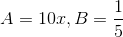 :
:


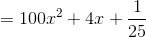
Use the perfect square trinomial pattern, setting
Expand:

Expand:
Tap to see back →
Use the perfect square trinomial pattern, setting  :
:



Use the perfect square trinomial pattern, setting
If 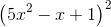 is expanded, what is the coefficient of
  ?
?
If
Tap to see back →
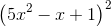






The coefficient of  is therefore 11.
The coefficient of
If 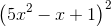 is expanded, what is the coefficient of
  ?
?
If
Tap to see back →
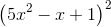






The coefficient of is therefore 10.
The coefficient of
Simplify the radical.
$\sqrt{3283}$
Simplify the radical.
$\sqrt{3283}$
Tap to see back →
We can break the square root down into 2 roots of 67 and 49. 49 is a perfect square and reduces to 7.
We can break the square root down into 2 roots of 67 and 49. 49 is a perfect square and reduces to 7.
Expand:
Expand:
Tap to see back →
Use the perfect square trinomial pattern, setting :
Use the perfect square trinomial pattern, setting
Expand:
Expand:
Tap to see back →
Use the perfect square trinomial pattern, setting :
Use the perfect square trinomial pattern, setting
If is expanded, what is the coefficient of ?
If
Tap to see back →
The coefficient of is therefore 11.
The coefficient of
If is expanded, what is the coefficient of ?
If
Tap to see back →
The coefficient of is therefore 10.
The coefficient of
Simplify the radical.
$\sqrt{3283}$
Simplify the radical.
$\sqrt{3283}$
Tap to see back →
We can break the square root down into 2 roots of 67 and 49. 49 is a perfect square and reduces to 7.
We can break the square root down into 2 roots of 67 and 49. 49 is a perfect square and reduces to 7.
Expand:
Expand:
Tap to see back →
Use the perfect square trinomial pattern, setting :
Use the perfect square trinomial pattern, setting
Expand:
Expand:
Tap to see back →
Use the perfect square trinomial pattern, setting :
Use the perfect square trinomial pattern, setting
If is expanded, what is the coefficient of ?
If
Tap to see back →
The coefficient of is therefore 11.
The coefficient of
If is expanded, what is the coefficient of ?
If
Tap to see back →
The coefficient of is therefore 10.
The coefficient of
Simplify the radical.
$\sqrt{3283}$
Simplify the radical.
$\sqrt{3283}$
Tap to see back →
We can break the square root down into 2 roots of 67 and 49. 49 is a perfect square and reduces to 7.
We can break the square root down into 2 roots of 67 and 49. 49 is a perfect square and reduces to 7.
Expand:
Expand:
Tap to see back →
Use the perfect square trinomial pattern, setting :
Use the perfect square trinomial pattern, setting
Expand:
Expand:
Tap to see back →
Use the perfect square trinomial pattern, setting :
Use the perfect square trinomial pattern, setting
If is expanded, what is the coefficient of ?
If
Tap to see back →
The coefficient of is therefore 11.
The coefficient of
If is expanded, what is the coefficient of ?
If
Tap to see back →
The coefficient of is therefore 10.
The coefficient of