How to find the square of an integer - PSAT Math
Card 0 of 56
The square root of 5184 is:
The square root of 5184 is:
Tap to see back →
The easiest way to narrow down a square root from a list is to look at the last number on the squared number – in this case 4 – and compare it to the last number of the answer.
70 * 70 will equal XXX0
71 * 71 will equal XXX1
72 * 72 will equal XXX4
73 * 73 will equal XXX9
74 * 74 will equal XXX(1)6
Therefore 72 is the answer. Check by multiplying it out.
The easiest way to narrow down a square root from a list is to look at the last number on the squared number – in this case 4 – and compare it to the last number of the answer.
70 * 70 will equal XXX0
71 * 71 will equal XXX1
72 * 72 will equal XXX4
73 * 73 will equal XXX9
74 * 74 will equal XXX(1)6
Therefore 72 is the answer. Check by multiplying it out.
How many integers from 20 to 80, inclusive, are NOT the square of another integer?
How many integers from 20 to 80, inclusive, are NOT the square of another integer?
Tap to see back →
First list all the integers between 20 and 80 that are squares of another integer:
52 = 25
62 = 36
72 = 49
82 = 64
In total, there are 61 integers from 20 to 80, inclusive. 61 – 4 = 57
First list all the integers between 20 and 80 that are squares of another integer:
52 = 25
62 = 36
72 = 49
82 = 64
In total, there are 61 integers from 20 to 80, inclusive. 61 – 4 = 57
If x and y are integers and xy + y2 is even, which of the following statements must be true?
I. 3y is odd
II. y/2 is an integer
III. xy is even
If x and y are integers and xy + y2 is even, which of the following statements must be true?
I. 3y is odd
II. y/2 is an integer
III. xy is even
Tap to see back →
In order for the original statement to be true, the  and
and  terms must be either both odd or both even. Looking at each of the statements individually,
I. States that  is odd, but only odd values multiplied by 3 are odd. If
  was an even number, the result would be even. But
  can be either odd or even, depending on what
  equals. Thus this statement COULD be true but does not HAVE to be true.
II. States that  is an integer, and since only even numbers are cleanly divided by 2 (odd values result in a fraction) this ensures that
  is even. However,
  can also be odd, so this is a statement that COULD be true but does not HAVE to be true.
III. For exponents, only the base value determines whether it is even or odd - it does not indicate the value of y at all. Only even numbers raised to any power are even, thus, this ensures that  is even. But
  can be odd as well, so this statement COULD be true but does not HAVE to be true.
An example of two integers that will work violate conditions II and III is  and
and  .
.
 , and even number.
 is not an integer.
 is not even.
Furthermore, any combination of 2 even integers will make the original statement true, and violate the Statement I.
In order for the original statement to be true, the
I. States that
II. States that
III. For exponents, only the base value determines whether it is even or odd - it does not indicate the value of y at all. Only even numbers raised to any power are even, thus, this ensures that
An example of two integers that will work violate conditions II and III is
Furthermore, any combination of 2 even integers will make the original statement true, and violate the Statement I.
Consider the inequality:

Which of the following could be a value of  ?
?
Consider the inequality:
Which of the following could be a value of
Tap to see back →
Notice how $x^4$ is the greatest value. This often means that x is negative as $(-1)^n$=-1 when n is odd and $(-1)^n$=1 when n is even.
Let us examine the first choice, x=-$\frac{3}{4}$
$x^5$$=-$\frac{3^5$$}{4^5$}$=-$\frac{243}{1024}$> -$\frac{3}{4}$
This can only be true of a negative value that lies between zero and one.
Notice how $x^4$ is the greatest value. This often means that x is negative as $(-1)^n$=-1 when n is odd and $(-1)^n$=1 when n is even.
Let us examine the first choice, x=-$\frac{3}{4}$
$x^5$$=-$\frac{3^5$$}{4^5$}$=-$\frac{243}{1024}$> -$\frac{3}{4}$
This can only be true of a negative value that lies between zero and one.
If $5^{x}$$+5^{x}$$+5^{x}$$+5^{x}$$+5^{x}$$=5^{10}$, what is the value of x?
If $5^{x}$$+5^{x}$$+5^{x}$$+5^{x}$$+5^{x}$$=5^{10}$, what is the value of x?
Tap to see back →
$5(5^{x}$$)=5^{10}$
$5^{1}$$(5^{x}$$)=5^{10}$
$5^{x+1}$$=5^{10}$
x=9
$5(5^{x}$$)=5^{10}$
$5^{1}$$(5^{x}$$)=5^{10}$
$5^{x+1}$$=5^{10}$
x=9
Simplify.

Simplify.
Tap to see back →

Take the square root of both the top and bottom terms.

Simplify.

Take the square root of both the top and bottom terms.
Simplify.
Let the universal set  be the set of all positive integers.
Let  be the set of all multiples of 3; let
  be the set of all multiples of 7; let
  be the set of all perfect square integers. Which of the following statements is true of 243?
Note:  means "the complement of
  ", etc.
Let the universal set
Let
Note:
Tap to see back →
 , so 243 is divisible by 3.
  .
.
 , so 243 is not divisible by 7.
  - that is,
  .
.
 , 243 is not a perfect square integer.
  - that is,
  .
.
Since 243 is an element of  ,
,  , and
, and  , it is an element of their intersection. The correct choice is that

Since 243 is an element of
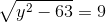
In the equation above, if  is a positive integer, what is the value of
  ?
?
In the equation above, if
Tap to see back →
Begin by squaring both sides of the equation:
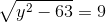


Now solve for y:



Note that  must be positive as defined in the original question. In this case,
  must be 12.
Begin by squaring both sides of the equation:
Now solve for y:
Note that
The square root of 5184 is:
The square root of 5184 is:
Tap to see back →
The easiest way to narrow down a square root from a list is to look at the last number on the squared number – in this case 4 – and compare it to the last number of the answer.
70 * 70 will equal XXX0
71 * 71 will equal XXX1
72 * 72 will equal XXX4
73 * 73 will equal XXX9
74 * 74 will equal XXX(1)6
Therefore 72 is the answer. Check by multiplying it out.
The easiest way to narrow down a square root from a list is to look at the last number on the squared number – in this case 4 – and compare it to the last number of the answer.
70 * 70 will equal XXX0
71 * 71 will equal XXX1
72 * 72 will equal XXX4
73 * 73 will equal XXX9
74 * 74 will equal XXX(1)6
Therefore 72 is the answer. Check by multiplying it out.
How many integers from 20 to 80, inclusive, are NOT the square of another integer?
How many integers from 20 to 80, inclusive, are NOT the square of another integer?
Tap to see back →
First list all the integers between 20 and 80 that are squares of another integer:
52 = 25
62 = 36
72 = 49
82 = 64
In total, there are 61 integers from 20 to 80, inclusive. 61 – 4 = 57
First list all the integers between 20 and 80 that are squares of another integer:
52 = 25
62 = 36
72 = 49
82 = 64
In total, there are 61 integers from 20 to 80, inclusive. 61 – 4 = 57
If x and y are integers and xy + y2 is even, which of the following statements must be true?
I. 3y is odd
II. y/2 is an integer
III. xy is even
If x and y are integers and xy + y2 is even, which of the following statements must be true?
I. 3y is odd
II. y/2 is an integer
III. xy is even
Tap to see back →
In order for the original statement to be true, the and terms must be either both odd or both even. Looking at each of the statements individually,
I. States that is odd, but only odd values multiplied by 3 are odd. If was an even number, the result would be even. But can be either odd or even, depending on what equals. Thus this statement COULD be true but does not HAVE to be true.
II. States that is an integer, and since only even numbers are cleanly divided by 2 (odd values result in a fraction) this ensures that is even. However, can also be odd, so this is a statement that COULD be true but does not HAVE to be true.
III. For exponents, only the base value determines whether it is even or odd - it does not indicate the value of y at all. Only even numbers raised to any power are even, thus, this ensures that is even. But can be odd as well, so this statement COULD be true but does not HAVE to be true.
An example of two integers that will work violate conditions II and III is and .
, and even number.
is not an integer.
is not even.
Furthermore, any combination of 2 even integers will make the original statement true, and violate the Statement I.
In order for the original statement to be true, the
I. States that
II. States that
III. For exponents, only the base value determines whether it is even or odd - it does not indicate the value of y at all. Only even numbers raised to any power are even, thus, this ensures that
An example of two integers that will work violate conditions II and III is
Furthermore, any combination of 2 even integers will make the original statement true, and violate the Statement I.
Consider the inequality:
Which of the following could be a value of ?
Consider the inequality:
Which of the following could be a value of
Tap to see back →
Notice how $x^4$ is the greatest value. This often means that x is negative as $(-1)^n$=-1 when n is odd and $(-1)^n$=1 when n is even.
Let us examine the first choice, x=-$\frac{3}{4}$
$x^5$$=-$\frac{3^5$$}{4^5$}$=-$\frac{243}{1024}$> -$\frac{3}{4}$
This can only be true of a negative value that lies between zero and one.
Notice how $x^4$ is the greatest value. This often means that x is negative as $(-1)^n$=-1 when n is odd and $(-1)^n$=1 when n is even.
Let us examine the first choice, x=-$\frac{3}{4}$
$x^5$$=-$\frac{3^5$$}{4^5$}$=-$\frac{243}{1024}$> -$\frac{3}{4}$
This can only be true of a negative value that lies between zero and one.
If $5^{x}$$+5^{x}$$+5^{x}$$+5^{x}$$+5^{x}$$=5^{10}$, what is the value of x?
If $5^{x}$$+5^{x}$$+5^{x}$$+5^{x}$$+5^{x}$$=5^{10}$, what is the value of x?
Tap to see back →
$5(5^{x}$$)=5^{10}$
$5^{1}$$(5^{x}$$)=5^{10}$
$5^{x+1}$$=5^{10}$
x=9
$5(5^{x}$$)=5^{10}$
$5^{1}$$(5^{x}$$)=5^{10}$
$5^{x+1}$$=5^{10}$
x=9
Simplify.
Simplify.
Tap to see back →
Take the square root of both the top and bottom terms.
Simplify.
Take the square root of both the top and bottom terms.
Simplify.
Let the universal set be the set of all positive integers.
Let be the set of all multiples of 3; let be the set of all multiples of 7; let be the set of all perfect square integers. Which of the following statements is true of 243?
Note: means "the complement of ", etc.
Let the universal set
Let
Note:
Tap to see back →
, so 243 is divisible by 3. .
, so 243 is not divisible by 7. - that is, .
, 243 is not a perfect square integer. - that is, .
Since 243 is an element of , , and , it is an element of their intersection. The correct choice is that
Since 243 is an element of
In the equation above, if is a positive integer, what is the value of ?
In the equation above, if
Tap to see back →
Begin by squaring both sides of the equation:
Now solve for y:
Note that must be positive as defined in the original question. In this case, must be 12.
Begin by squaring both sides of the equation:
Now solve for y:
Note that
The square root of 5184 is:
The square root of 5184 is:
Tap to see back →
The easiest way to narrow down a square root from a list is to look at the last number on the squared number – in this case 4 – and compare it to the last number of the answer.
70 * 70 will equal XXX0
71 * 71 will equal XXX1
72 * 72 will equal XXX4
73 * 73 will equal XXX9
74 * 74 will equal XXX(1)6
Therefore 72 is the answer. Check by multiplying it out.
The easiest way to narrow down a square root from a list is to look at the last number on the squared number – in this case 4 – and compare it to the last number of the answer.
70 * 70 will equal XXX0
71 * 71 will equal XXX1
72 * 72 will equal XXX4
73 * 73 will equal XXX9
74 * 74 will equal XXX(1)6
Therefore 72 is the answer. Check by multiplying it out.
How many integers from 20 to 80, inclusive, are NOT the square of another integer?
How many integers from 20 to 80, inclusive, are NOT the square of another integer?
Tap to see back →
First list all the integers between 20 and 80 that are squares of another integer:
52 = 25
62 = 36
72 = 49
82 = 64
In total, there are 61 integers from 20 to 80, inclusive. 61 – 4 = 57
First list all the integers between 20 and 80 that are squares of another integer:
52 = 25
62 = 36
72 = 49
82 = 64
In total, there are 61 integers from 20 to 80, inclusive. 61 – 4 = 57
If x and y are integers and xy + y2 is even, which of the following statements must be true?
I. 3y is odd
II. y/2 is an integer
III. xy is even
If x and y are integers and xy + y2 is even, which of the following statements must be true?
I. 3y is odd
II. y/2 is an integer
III. xy is even
Tap to see back →
In order for the original statement to be true, the and terms must be either both odd or both even. Looking at each of the statements individually,
I. States that is odd, but only odd values multiplied by 3 are odd. If was an even number, the result would be even. But can be either odd or even, depending on what equals. Thus this statement COULD be true but does not HAVE to be true.
II. States that is an integer, and since only even numbers are cleanly divided by 2 (odd values result in a fraction) this ensures that is even. However, can also be odd, so this is a statement that COULD be true but does not HAVE to be true.
III. For exponents, only the base value determines whether it is even or odd - it does not indicate the value of y at all. Only even numbers raised to any power are even, thus, this ensures that is even. But can be odd as well, so this statement COULD be true but does not HAVE to be true.
An example of two integers that will work violate conditions II and III is and .
, and even number.
is not an integer.
is not even.
Furthermore, any combination of 2 even integers will make the original statement true, and violate the Statement I.
In order for the original statement to be true, the
I. States that
II. States that
III. For exponents, only the base value determines whether it is even or odd - it does not indicate the value of y at all. Only even numbers raised to any power are even, thus, this ensures that
An example of two integers that will work violate conditions II and III is
Furthermore, any combination of 2 even integers will make the original statement true, and violate the Statement I.
Consider the inequality:
Which of the following could be a value of ?
Consider the inequality:
Which of the following could be a value of
Tap to see back →
Notice how $x^4$ is the greatest value. This often means that x is negative as $(-1)^n$=-1 when n is odd and $(-1)^n$=1 when n is even.
Let us examine the first choice, x=-$\frac{3}{4}$
$x^5$$=-$\frac{3^5$$}{4^5$}$=-$\frac{243}{1024}$> -$\frac{3}{4}$
This can only be true of a negative value that lies between zero and one.
Notice how $x^4$ is the greatest value. This often means that x is negative as $(-1)^n$=-1 when n is odd and $(-1)^n$=1 when n is even.
Let us examine the first choice, x=-$\frac{3}{4}$
$x^5$$=-$\frac{3^5$$}{4^5$}$=-$\frac{243}{1024}$> -$\frac{3}{4}$
This can only be true of a negative value that lies between zero and one.