How to multiply fractions - PSAT Math
Card 0 of 56
In a group of 20 children, 25% are girls. How many boys are there?
In a group of 20 children, 25% are girls. How many boys are there?
Tap to see back →
Since $\frac{1}{4}$ of the children are girls, this totals to 20 times $\frac{1}{4}$ = 5 girls in the group.
20-5=15 boys.
Since $\frac{1}{4}$ of the children are girls, this totals to 20 times $\frac{1}{4}$ = 5 girls in the group.
20-5=15 boys.
If xy = 1 and 0 < x < 1, then which of the following must be true?
If xy = 1 and 0 < x < 1, then which of the following must be true?
Tap to see back →
If x is between 0 and 1, it must be a proper fraction (e.g., ½ or ¼). Solving the first equation for y, y = 1/x. When you divide 1 by a proper fraction between 0 and 1, the result is the reciprocal of that fraction, which will always be greater than 1.
To test this out, pick any fraction. Say x = ½. This makes y = 2.
If x is between 0 and 1, it must be a proper fraction (e.g., ½ or ¼). Solving the first equation for y, y = 1/x. When you divide 1 by a proper fraction between 0 and 1, the result is the reciprocal of that fraction, which will always be greater than 1.
To test this out, pick any fraction. Say x = ½. This makes y = 2.
Before going to school, Joey ran 1/3 of his daily total miles. In gym class, Joey did 2/3 of the remainder. What part of his daily total miles was left for after school?
Before going to school, Joey ran 1/3 of his daily total miles. In gym class, Joey did 2/3 of the remainder. What part of his daily total miles was left for after school?
Tap to see back →
Before school, Joey did 1/3 of the total miles. In school, Joey did 2/3 of the remaining 2/3, or 4/9 of the running. When added to his in school run, his before school run of 3/9 brings his completed miles to 7/9 of his dialy total. Thus, only 2/9 of the total miles are left for after school.
Before school, Joey did 1/3 of the total miles. In school, Joey did 2/3 of the remaining 2/3, or 4/9 of the running. When added to his in school run, his before school run of 3/9 brings his completed miles to 7/9 of his dialy total. Thus, only 2/9 of the total miles are left for after school.
Sally bought five computers for her office that cost $300, $405, $485, $520, and $555 respectively. She made a down payment of 2/5 the total cost and paid the rest in nine equal payments over the next nine months. Assuming no tax and no interest, what is the value of each of the nine payments?
Sally bought five computers for her office that cost $300, $405, $485, $520, and $555 respectively. She made a down payment of 2/5 the total cost and paid the rest in nine equal payments over the next nine months. Assuming no tax and no interest, what is the value of each of the nine payments?
Tap to see back →
The total cost of the 5 computers is 2265.
2/5 of 2265 = 906, which is what Sally pays up front.
2265 – 906 = 1359, which is what Sally still owes.
1359/9 = 151, which is the value of each of the 9 equal payments.
The total cost of the 5 computers is 2265.
2/5 of 2265 = 906, which is what Sally pays up front.
2265 – 906 = 1359, which is what Sally still owes.
1359/9 = 151, which is the value of each of the 9 equal payments.
The price of a computer is reduced by 1/8. The new price is then reduced by 1/6. What fraction of the original price is the current price?
The price of a computer is reduced by 1/8. The new price is then reduced by 1/6. What fraction of the original price is the current price?
Tap to see back →
Let the original price = p.
After the first reduction, the price is (7/8)p
After the second reduction, the price is (5/6)(7/8)p = (35/48)p
Let the original price = p.
After the first reduction, the price is (7/8)p
After the second reduction, the price is (5/6)(7/8)p = (35/48)p
If a car travels at 30 mph, how many feet per second does travel?
If a car travels at 30 mph, how many feet per second does travel?
Tap to see back →
30 miles / 1 hour * 5280 ft / 1 mile * 3600 seconds / 1 hour = 44 ft/sec
30 miles / 1 hour * 5280 ft / 1 mile * 3600 seconds / 1 hour = 44 ft/sec

Tap to see back →
Remember, when you multiply fractions, you can directly multiply their denominators and their numerators; therefore, you can begin this problem by making it into one large fraction:
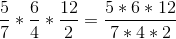
Now, you could multiply all of this out and then divide. However, you can cancel things immediately. The  goes into the
  and the
  into the
  . Thus, you have:

Remember, when you multiply fractions, you can directly multiply their denominators and their numerators; therefore, you can begin this problem by making it into one large fraction:
Now, you could multiply all of this out and then divide. However, you can cancel things immediately. The
Simplify:
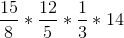
Simplify:
Tap to see back →
First, begin by remembering that  is the same as
  :
:
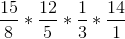
Next, recall that you multiply fractions by multiplying the numerators and denominators by each other. It is very simple. This would give you:

Now, you can cancel the  and the
  :
:

Next, you can reduce the  and the
  :
:

You can also reduce the resulting  and the
  :
:

First, begin by remembering that
Next, recall that you multiply fractions by multiplying the numerators and denominators by each other. It is very simple. This would give you:
Now, you can cancel the
Next, you can reduce the
You can also reduce the resulting
Sally bought five computers for her office that cost $300, $405, $485, $520, and $555 respectively. She made a down payment of 2/5 the total cost and paid the rest in nine equal payments over the next nine months. Assuming no tax and no interest, what is the value of each of the nine payments?
Sally bought five computers for her office that cost $300, $405, $485, $520, and $555 respectively. She made a down payment of 2/5 the total cost and paid the rest in nine equal payments over the next nine months. Assuming no tax and no interest, what is the value of each of the nine payments?
Tap to see back →
The total cost of the 5 computers is 2265.
2/5 of 2265 = 906, which is what Sally pays up front.
2265 – 906 = 1359, which is what Sally still owes.
1359/9 = 151, which is the value of each of the 9 equal payments.
The total cost of the 5 computers is 2265.
2/5 of 2265 = 906, which is what Sally pays up front.
2265 – 906 = 1359, which is what Sally still owes.
1359/9 = 151, which is the value of each of the 9 equal payments.
The price of a computer is reduced by 1/8. The new price is then reduced by 1/6. What fraction of the original price is the current price?
The price of a computer is reduced by 1/8. The new price is then reduced by 1/6. What fraction of the original price is the current price?
Tap to see back →
Let the original price = p.
After the first reduction, the price is (7/8)p
After the second reduction, the price is (5/6)(7/8)p = (35/48)p
Let the original price = p.
After the first reduction, the price is (7/8)p
After the second reduction, the price is (5/6)(7/8)p = (35/48)p
If a car travels at 30 mph, how many feet per second does travel?
If a car travels at 30 mph, how many feet per second does travel?
Tap to see back →
30 miles / 1 hour * 5280 ft / 1 mile * 3600 seconds / 1 hour = 44 ft/sec
30 miles / 1 hour * 5280 ft / 1 mile * 3600 seconds / 1 hour = 44 ft/sec
In a group of 20 children, 25% are girls. How many boys are there?
In a group of 20 children, 25% are girls. How many boys are there?
Tap to see back →
Since $\frac{1}{4}$ of the children are girls, this totals to 20 times $\frac{1}{4}$ = 5 girls in the group.
20-5=15 boys.
Since $\frac{1}{4}$ of the children are girls, this totals to 20 times $\frac{1}{4}$ = 5 girls in the group.
20-5=15 boys.
If xy = 1 and 0 < x < 1, then which of the following must be true?
If xy = 1 and 0 < x < 1, then which of the following must be true?
Tap to see back →
If x is between 0 and 1, it must be a proper fraction (e.g., ½ or ¼). Solving the first equation for y, y = 1/x. When you divide 1 by a proper fraction between 0 and 1, the result is the reciprocal of that fraction, which will always be greater than 1.
To test this out, pick any fraction. Say x = ½. This makes y = 2.
If x is between 0 and 1, it must be a proper fraction (e.g., ½ or ¼). Solving the first equation for y, y = 1/x. When you divide 1 by a proper fraction between 0 and 1, the result is the reciprocal of that fraction, which will always be greater than 1.
To test this out, pick any fraction. Say x = ½. This makes y = 2.
Before going to school, Joey ran 1/3 of his daily total miles. In gym class, Joey did 2/3 of the remainder. What part of his daily total miles was left for after school?
Before going to school, Joey ran 1/3 of his daily total miles. In gym class, Joey did 2/3 of the remainder. What part of his daily total miles was left for after school?
Tap to see back →
Before school, Joey did 1/3 of the total miles. In school, Joey did 2/3 of the remaining 2/3, or 4/9 of the running. When added to his in school run, his before school run of 3/9 brings his completed miles to 7/9 of his dialy total. Thus, only 2/9 of the total miles are left for after school.
Before school, Joey did 1/3 of the total miles. In school, Joey did 2/3 of the remaining 2/3, or 4/9 of the running. When added to his in school run, his before school run of 3/9 brings his completed miles to 7/9 of his dialy total. Thus, only 2/9 of the total miles are left for after school.
Tap to see back →
Remember, when you multiply fractions, you can directly multiply their denominators and their numerators; therefore, you can begin this problem by making it into one large fraction:
Now, you could multiply all of this out and then divide. However, you can cancel things immediately. The goes into the and the into the . Thus, you have:
Remember, when you multiply fractions, you can directly multiply their denominators and their numerators; therefore, you can begin this problem by making it into one large fraction:
Now, you could multiply all of this out and then divide. However, you can cancel things immediately. The
Simplify:
Simplify:
Tap to see back →
First, begin by remembering that is the same as :
Next, recall that you multiply fractions by multiplying the numerators and denominators by each other. It is very simple. This would give you:
Now, you can cancel the and the :
Next, you can reduce the and the :
You can also reduce the resulting and the :
First, begin by remembering that
Next, recall that you multiply fractions by multiplying the numerators and denominators by each other. It is very simple. This would give you:
Now, you can cancel the
Next, you can reduce the
You can also reduce the resulting
If a car travels at 30 mph, how many feet per second does travel?
If a car travels at 30 mph, how many feet per second does travel?
Tap to see back →
30 miles / 1 hour * 5280 ft / 1 mile * 3600 seconds / 1 hour = 44 ft/sec
30 miles / 1 hour * 5280 ft / 1 mile * 3600 seconds / 1 hour = 44 ft/sec
Before going to school, Joey ran 1/3 of his daily total miles. In gym class, Joey did 2/3 of the remainder. What part of his daily total miles was left for after school?
Before going to school, Joey ran 1/3 of his daily total miles. In gym class, Joey did 2/3 of the remainder. What part of his daily total miles was left for after school?
Tap to see back →
Before school, Joey did 1/3 of the total miles. In school, Joey did 2/3 of the remaining 2/3, or 4/9 of the running. When added to his in school run, his before school run of 3/9 brings his completed miles to 7/9 of his dialy total. Thus, only 2/9 of the total miles are left for after school.
Before school, Joey did 1/3 of the total miles. In school, Joey did 2/3 of the remaining 2/3, or 4/9 of the running. When added to his in school run, his before school run of 3/9 brings his completed miles to 7/9 of his dialy total. Thus, only 2/9 of the total miles are left for after school.
Sally bought five computers for her office that cost $300, $405, $485, $520, and $555 respectively. She made a down payment of 2/5 the total cost and paid the rest in nine equal payments over the next nine months. Assuming no tax and no interest, what is the value of each of the nine payments?
Sally bought five computers for her office that cost $300, $405, $485, $520, and $555 respectively. She made a down payment of 2/5 the total cost and paid the rest in nine equal payments over the next nine months. Assuming no tax and no interest, what is the value of each of the nine payments?
Tap to see back →
The total cost of the 5 computers is 2265.
2/5 of 2265 = 906, which is what Sally pays up front.
2265 – 906 = 1359, which is what Sally still owes.
1359/9 = 151, which is the value of each of the 9 equal payments.
The total cost of the 5 computers is 2265.
2/5 of 2265 = 906, which is what Sally pays up front.
2265 – 906 = 1359, which is what Sally still owes.
1359/9 = 151, which is the value of each of the 9 equal payments.
The price of a computer is reduced by 1/8. The new price is then reduced by 1/6. What fraction of the original price is the current price?
The price of a computer is reduced by 1/8. The new price is then reduced by 1/6. What fraction of the original price is the current price?
Tap to see back →
Let the original price = p.
After the first reduction, the price is (7/8)p
After the second reduction, the price is (5/6)(7/8)p = (35/48)p
Let the original price = p.
After the first reduction, the price is (7/8)p
After the second reduction, the price is (5/6)(7/8)p = (35/48)p