How to subtract rational expressions with different denominators - PSAT Math
Card 0 of 7
Simplify.
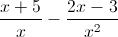
Simplify.
Tap to see back →
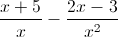
Determine an LCD (Least Common Denominator) between  and
and  .
.
LCD = 
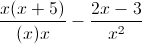
Multiply the top and bottom of the first rational expression by  , so that the denominator will be
  .
.
Distribute the  to
to  .
.
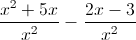
Now you can subtract because both rational expressions have the same denominators.
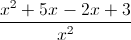
Final Answer.

Determine an LCD (Least Common Denominator) between
LCD =
Multiply the top and bottom of the first rational expression by
Distribute the
Now you can subtract because both rational expressions have the same denominators.
Final Answer.
Simplify.
Simplify.
Tap to see back →
Determine an LCD (Least Common Denominator) between and .
LCD =
Multiply the top and bottom of the first rational expression by , so that the denominator will be .
Distribute the to .
Now you can subtract because both rational expressions have the same denominators.
Final Answer.
Determine an LCD (Least Common Denominator) between
LCD =
Multiply the top and bottom of the first rational expression by
Distribute the
Now you can subtract because both rational expressions have the same denominators.
Final Answer.
Simplify.
Simplify.
Tap to see back →
Determine an LCD (Least Common Denominator) between and .
LCD =
Multiply the top and bottom of the first rational expression by , so that the denominator will be .
Distribute the to .
Now you can subtract because both rational expressions have the same denominators.
Final Answer.
Determine an LCD (Least Common Denominator) between
LCD =
Multiply the top and bottom of the first rational expression by
Distribute the
Now you can subtract because both rational expressions have the same denominators.
Final Answer.
Simplify.
Simplify.
Tap to see back →
Determine an LCD (Least Common Denominator) between and .
LCD =
Multiply the top and bottom of the first rational expression by , so that the denominator will be .
Distribute the to .
Now you can subtract because both rational expressions have the same denominators.
Final Answer.
Determine an LCD (Least Common Denominator) between
LCD =
Multiply the top and bottom of the first rational expression by
Distribute the
Now you can subtract because both rational expressions have the same denominators.
Final Answer.
Simplify.
Simplify.
Tap to see back →
Determine an LCD (Least Common Denominator) between and .
LCD =
Multiply the top and bottom of the first rational expression by , so that the denominator will be .
Distribute the to .
Now you can subtract because both rational expressions have the same denominators.
Final Answer.
Determine an LCD (Least Common Denominator) between
LCD =
Multiply the top and bottom of the first rational expression by
Distribute the
Now you can subtract because both rational expressions have the same denominators.
Final Answer.
Simplify.
Simplify.
Tap to see back →
Determine an LCD (Least Common Denominator) between and .
LCD =
Multiply the top and bottom of the first rational expression by , so that the denominator will be .
Distribute the to .
Now you can subtract because both rational expressions have the same denominators.
Final Answer.
Determine an LCD (Least Common Denominator) between
LCD =
Multiply the top and bottom of the first rational expression by
Distribute the
Now you can subtract because both rational expressions have the same denominators.
Final Answer.
Simplify.
Simplify.
Tap to see back →
Determine an LCD (Least Common Denominator) between and .
LCD =
Multiply the top and bottom of the first rational expression by , so that the denominator will be .
Distribute the to .
Now you can subtract because both rational expressions have the same denominators.
Final Answer.
Determine an LCD (Least Common Denominator) between
LCD =
Multiply the top and bottom of the first rational expression by
Distribute the
Now you can subtract because both rational expressions have the same denominators.
Final Answer.