Data Analysis and Probability - SSAT Elementary Level Quantitative
Card 1 of 1472
Ten cards each have a number printed on them. Five have a 1 printed on them, three have a 2, and two have a 3. The cards are shuffled and a card is dealt. What is the probability that the card will not be a 3?
Ten cards each have a number printed on them. Five have a 1 printed on them, three have a 2, and two have a 3. The cards are shuffled and a card is dealt. What is the probability that the card will not be a 3?
Tap to reveal answer
There are ten cards total, and eight cards that are not threes. This makes the probability of drawing a three

There are ten cards total, and eight cards that are not threes. This makes the probability of drawing a three
← Didn't Know|Knew It →
Express the probability as a fraction.
Nija has 7 marbles. There are 2 red, 3 blue, and 2 yellow. What is the probablilty that Nija will choose a red marble?
Express the probability as a fraction.
Nija has 7 marbles. There are 2 red, 3 blue, and 2 yellow. What is the probablilty that Nija will choose a red marble?
Tap to reveal answer
Probability can be expressed as a fraction:

Our fraction is  .
.
Since there are 2 red marbles out of 7 total marbles, the probability of choosing a red marble is  .
.
Probability can be expressed as a fraction:
Our fraction is
Since there are 2 red marbles out of 7 total marbles, the probability of choosing a red marble is
← Didn't Know|Knew It →
A ring toss game has 25 bottles, 5 of which are yellow. If you toss a ring around a yellow bottle, you win the grand prize. What is the probability of winning the grand prize? (Give the fraction in simplest form.)
A ring toss game has 25 bottles, 5 of which are yellow. If you toss a ring around a yellow bottle, you win the grand prize. What is the probability of winning the grand prize? (Give the fraction in simplest form.)
Tap to reveal answer
To find the probability of an outcome, set up a fraction.

Since there are 5 yellow (part) out of 25 bottles (total possible) the fraction looks like this:  .
.
Reduce the fraction by dividing the top and bottom by 5:

This is the probability of winning the grand prize.
To find the probability of an outcome, set up a fraction.
Since there are 5 yellow (part) out of 25 bottles (total possible) the fraction looks like this:
Reduce the fraction by dividing the top and bottom by 5:
This is the probability of winning the grand prize.
← Didn't Know|Knew It →
A magician holds in his bag 3 green balls, 4 red balls and 7 blue balls. What is the probability of drawing a red ball from the bag?
A magician holds in his bag 3 green balls, 4 red balls and 7 blue balls. What is the probability of drawing a red ball from the bag?
Tap to reveal answer
Probability = total number of possible outcomes/sample space.
= 
= 
Probability = total number of possible outcomes/sample space.
=
=
← Didn't Know|Knew It →
If there are 2 blue marbles and 18 red marbles in a jar, what is the probability that Jeff will pick out a red marble?
If there are 2 blue marbles and 18 red marbles in a jar, what is the probability that Jeff will pick out a red marble?
Tap to reveal answer
First, add the total number of marbles, which is  . There are 18 red marbles, so you set up a fraction
  .
.
If you simplify by dividing the numerator and denominator by 2, you get  .
.
First, add the total number of marbles, which is
If you simplify by dividing the numerator and denominator by 2, you get
← Didn't Know|Knew It →
In a restaurant there are two managers, three workers, and twelve guests. What is the probability that a person chosen at random is a worker?
In a restaurant there are two managers, three workers, and twelve guests. What is the probability that a person chosen at random is a worker?
Tap to reveal answer
The total number of people in the room is the sum of all the different types of people:

The probability of choosing a worker is the number of workers divided by the total number of people. There are three workers and seventeen people in total:

The total number of people in the room is the sum of all the different types of people:
The probability of choosing a worker is the number of workers divided by the total number of people. There are three workers and seventeen people in total:
← Didn't Know|Knew It →
Find the probability of an outcome. Express the outcome as fraction, reduced to its lowest terms.
Mr. Thomas went to a car lot to buy a new car. Of the 68 cars on the lot, 22 were black, 16 were silver, 8 were white, 12 were blue, and 10 were red. What is the probability that Mr. Thomas will buy a blue car?
Find the probability of an outcome. Express the outcome as fraction, reduced to its lowest terms.
Mr. Thomas went to a car lot to buy a new car. Of the 68 cars on the lot, 22 were black, 16 were silver, 8 were white, 12 were blue, and 10 were red. What is the probability that Mr. Thomas will buy a blue car?
Tap to reveal answer
To find the probability of an outcome, set up a fraction:
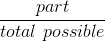
Since there are 12 blue cars (part) out of 68 cars in all (total possible) the fraction looks like this:

If you reduce the fraction by 4 (because the numerator and the denominator are both divisible by 4 which makes 4 the GCF (greatest common factor), it becomes:

To find the probability of an outcome, set up a fraction:
Since there are 12 blue cars (part) out of 68 cars in all (total possible) the fraction looks like this:
If you reduce the fraction by 4 (because the numerator and the denominator are both divisible by 4 which makes 4 the GCF (greatest common factor), it becomes:
← Didn't Know|Knew It →
There are 10 marbles in a bag:
7 red
2 blue
1 yellow
What is the probability of choosing a red ball out of the bag?
There are 10 marbles in a bag:
7 red
2 blue
1 yellow
What is the probability of choosing a red ball out of the bag?
Tap to reveal answer
To find the probability of an outcome, set up a fraction:

Since there are 7 red marbles (part) out of 10 marbles in all (total possible) the fraction looks like this:

To find the probability of an outcome, set up a fraction:
Since there are 7 red marbles (part) out of 10 marbles in all (total possible) the fraction looks like this:
← Didn't Know|Knew It →
A bag contains  red socks and
  purple socks. What is the chance that I pick a purple sock from the bag?
A bag contains
Tap to reveal answer
To find the probability of picking a purple sock from the bag of socks, we need to set up a fraction like this:  . The problem tells us that we have
  purple socks, so we can put that on the top of the fraction. The total number of socks is equal to
  purple socks +
  red socks, giving us a sum of
  (which goes on the bottom of the fraction). That gives us a
  chance of picking a purple sock from the bag!
To find the probability of picking a purple sock from the bag of socks, we need to set up a fraction like this:
← Didn't Know|Knew It →
Mikey has a box filled with cookies. He has 6 chocolate chip cookies, 4 sugar cookies, and 2 oatmeal raisin cookies. What is the chance that Mikey picks a sugar cookie out of the box?
Mikey has a box filled with cookies. He has 6 chocolate chip cookies, 4 sugar cookies, and 2 oatmeal raisin cookies. What is the chance that Mikey picks a sugar cookie out of the box?
Tap to reveal answer
To find the probability of picking a sugar cookie from the bag of cookies, we need to set up a fraction like this:

The problem tells us that Mikey has 4 sugar cookies, so we can put that on the top of the fraction. The total number of cookies is equal to 6 chocolate chip cookies + 4 sugar cookies + 2 oatmeal raisin cookies, giving us a sum of 12 (which goes on the bottom of the fraction). That gives Mikey a  chance of picking a sugar cookie!
To find the probability of picking a sugar cookie from the bag of cookies, we need to set up a fraction like this:
The problem tells us that Mikey has 4 sugar cookies, so we can put that on the top of the fraction. The total number of cookies is equal to 6 chocolate chip cookies + 4 sugar cookies + 2 oatmeal raisin cookies, giving us a sum of 12 (which goes on the bottom of the fraction). That gives Mikey a
← Didn't Know|Knew It →
Sofia has a pizza pie with 8 slices. 4 slices have pepperoni, 3 slices have mushrooms and 1 slice has olives. If Sofia randomly picks a piece of pizza to eat, what is the chance that the slice of pizza has mushrooms on it?
Sofia has a pizza pie with 8 slices. 4 slices have pepperoni, 3 slices have mushrooms and 1 slice has olives. If Sofia randomly picks a piece of pizza to eat, what is the chance that the slice of pizza has mushrooms on it?
Tap to reveal answer
To find the probability of picking a mushroom slice from the pizza pie, we should set up a fraction like this:

The problem tells us that we have 3 mushroom slices, so we can put that on the top of the fraction. The problem also tells us that we have 8 total slices in the pizza pie, so that can go on the bottom of the fraction. That gives Sofia a  chance of picking a mushroom slice!
To find the probability of picking a mushroom slice from the pizza pie, we should set up a fraction like this:
The problem tells us that we have 3 mushroom slices, so we can put that on the top of the fraction. The problem also tells us that we have 8 total slices in the pizza pie, so that can go on the bottom of the fraction. That gives Sofia a
← Didn't Know|Knew It →
Jenny buys two dozen donuts from the bakery. If 12 donuts are glazed, 6 donuts are jelly, 4 donuts are powdered and 2 donuts are plain, what is the chance that she will randomly pick a powdered donut from the box?
Jenny buys two dozen donuts from the bakery. If 12 donuts are glazed, 6 donuts are jelly, 4 donuts are powdered and 2 donuts are plain, what is the chance that she will randomly pick a powdered donut from the box?
Tap to reveal answer
To find the probability of picking a powdered donut from the box of donuts, we need to set up a fraction like this: . The problem tells us that we have 4 powdered donuts, so we can put that on the top of the fraction. The total number of donuts is 2 dozen, which is equal to 24 donuts (which goes on the bottom of the fraction). That gives Jenny a
  chance of picking a powdered donut from the box!
To find the probability of picking a powdered donut from the box of donuts, we need to set up a fraction like this:
← Didn't Know|Knew It →
Joey has 10 shirts on his bed. 4 shirts are blue, 3 shirts are purple, 2 shirts are green, and 1 shirt is white. What is the chance that Joey randomly picks a purple shirt from the shirts on his bed?
Joey has 10 shirts on his bed. 4 shirts are blue, 3 shirts are purple, 2 shirts are green, and 1 shirt is white. What is the chance that Joey randomly picks a purple shirt from the shirts on his bed?
Tap to reveal answer
To find the probability of picking a purple shirt from the pile of shirts on Joey's bed, we need to set up a fraction like this:

The problem tells us that Joey has 3 purple shirts, so we can put that in the numerator. We are also told that the total number of shirts on Joey's bed is 10, so 10 goes on the bottom of the fraction. Therefore, Joey has a  chance of picking a purple shirt.
To find the probability of picking a purple shirt from the pile of shirts on Joey's bed, we need to set up a fraction like this:
The problem tells us that Joey has 3 purple shirts, so we can put that in the numerator. We are also told that the total number of shirts on Joey's bed is 10, so 10 goes on the bottom of the fraction. Therefore, Joey has a
← Didn't Know|Knew It →
A bag of marbles contains  green marbles,
  blue marbles, and
  red marbles.
If  marbles are taken from the bag on each draw, what is the greatest possible amount of draws that can occur without drawing a red marble?
A bag of marbles contains
If
Tap to reveal answer
There are  green marbles and
  red marbles in the bag. Adding these amounts together gives
  marbles in the bag that are not red. If all
  of these were drawn before any red marble, this would require
  draws at
  marbles per draw (
 ). Therefore, it is possible to draw up to
  times without drawing a red marble.
There are
← Didn't Know|Knew It →
Sarah, Mitch, and Ben are going to a concert. If they are seated in a row of  , what fraction represents the probability Sarah will be seated in the middle of the row?
Sarah, Mitch, and Ben are going to a concert. If they are seated in a row of
Tap to reveal answer
The number of total possible arrangements of three items in a row is  , or
, or  .
.
We can write out all the possible arrangments and count the number in which Sarah sits in the middle.
-

-

-

-

-

-

In  out of
  possible arrangements, Sarah sits in the middle. Expressed as a fraction, this is
  , which is equivalent to
  .
.
The number of total possible arrangements of three items in a row is
We can write out all the possible arrangments and count the number in which Sarah sits in the middle.
In
← Didn't Know|Knew It →
Shannon has a box with 9 shirts inside. 4 shirts are pink, 3 shirts are yellow, 1 shirt is red, and 1 shirt is green. What is the probability that Shannon will randomly pick a pink shirt from the box?
Shannon has a box with 9 shirts inside. 4 shirts are pink, 3 shirts are yellow, 1 shirt is red, and 1 shirt is green. What is the probability that Shannon will randomly pick a pink shirt from the box?
Tap to reveal answer
To find the probability of picking a pink shirt from the box, we need to set up a fraction:  . The problem tells us that Shannon has 4 pink shirts, so we can put that on the top of the fraction. The total number of shirts is 9, which goes on the bottom of the fraction. That gives Shannon a
  chance of picking a pink shirt from the box!
To find the probability of picking a pink shirt from the box, we need to set up a fraction:
← Didn't Know|Knew It →
Tucker is going fishing at a local pond with 15 fish. 5 fish are tuna, 4 fish are salmon, 3 fish are yellowtail, and 3 fish are trout. What is the chance that the first fish Tucker catches will be a tuna or a trout?
Tucker is going fishing at a local pond with 15 fish. 5 fish are tuna, 4 fish are salmon, 3 fish are yellowtail, and 3 fish are trout. What is the chance that the first fish Tucker catches will be a tuna or a trout?
Tap to reveal answer
To find the probability of Tucker catching a tuna or a trout, we need to set up a fraction like this:  . The problem tells us that there are 5 tuna and 3 trout in the pond, so we can put 8 on the top of the fraction. The total number of fish in the pond is 15, so that goes on the bottom of the fraction. That gives Tucker an 8/15 chance of catching a tuna or trout!
To find the probability of Tucker catching a tuna or a trout, we need to set up a fraction like this:
← Didn't Know|Knew It →
Josh has  cards in his hand. These cards are each red, yellow, or blue. If
  of the cards are red and
  are yellow, what is the probability of drawing a blue card?
Josh has
Tap to reveal answer
Of the  cards Josh has in his hand,
  are red and
  are yellow. We need to figure out how many blue cards Josh must have in his hand. We are told that each of the cards in Josh's hand is either red, yellow, or blue, so if a card is not red or yellow, it is blue. Since
  cards that are red or yellow, the rest of the cards must be blue.
  , so there must be
  blue cards in Josh's hand. The total number of cards is
  , so the chance of drawing a blue card is
  .
.
Of the
← Didn't Know|Knew It →
Mikey has a box of chocolates. 5 chocolates have a caramel filling, 6 chocolates have an almond filling, 3 chocolates have no filling, and 1 chocolate has a cherry filling. If Mikey selects a chocolate from the box at random, what is the chance that he selects a chocolate with a filling?
Mikey has a box of chocolates. 5 chocolates have a caramel filling, 6 chocolates have an almond filling, 3 chocolates have no filling, and 1 chocolate has a cherry filling. If Mikey selects a chocolate from the box at random, what is the chance that he selects a chocolate with a filling?
Tap to reveal answer
To find the probability of Mikey selecting a piece of chocolate with a filling from the box of chocolates, we need to set up a fraction like this:  .
.
The problem tells us that we have 5 chocolates with a caramel filling, 6 chocolates with an almond filling, and 1 chocolate with a cherry filling. We need to add them all together to find out how many chocolates have any type of filling, and place that number on top of the above fraction.

Now, we need to add 3 more to the above number because the box has 3 chocolates with no filling, and then use that new number as our denominator (on the bottom of the fraction).

That gives Mikey a 12/15 chance of picking a filled chocolate from the box of chocolates!
To find the probability of Mikey selecting a piece of chocolate with a filling from the box of chocolates, we need to set up a fraction like this:
The problem tells us that we have 5 chocolates with a caramel filling, 6 chocolates with an almond filling, and 1 chocolate with a cherry filling. We need to add them all together to find out how many chocolates have any type of filling, and place that number on top of the above fraction.
Now, we need to add 3 more to the above number because the box has 3 chocolates with no filling, and then use that new number as our denominator (on the bottom of the fraction).
That gives Mikey a 12/15 chance of picking a filled chocolate from the box of chocolates!
← Didn't Know|Knew It →
Niall has a box of 6 scarves. 3 scarves are purple, 2 scarves are blue, and 1 scarf is white. What is the chance that Niall will randomly pick a blue scarf from the box?
Niall has a box of 6 scarves. 3 scarves are purple, 2 scarves are blue, and 1 scarf is white. What is the chance that Niall will randomly pick a blue scarf from the box?
Tap to reveal answer
To find the probability of picking a blue scarf from the box, we need to set up a fraction like this:  . The problem tells us that Niall has 2 blue scarves, so we can put that on the top of the fraction. The problem also tells us that Niall has a total of 6 scarves, so we can put that on the bottom of the fraction. That gives Niall a
  chance of picking a blue scarf from the box!
To find the probability of picking a blue scarf from the box, we need to set up a fraction like this:
← Didn't Know|Knew It →