Coordinate Geometry - SSAT Middle Level Quantitative
Card 0 of 168
Give the slope of the line that passes through  and
and  .
.
Give the slope of the line that passes through
Tap to see back →
Use the slope formula, substituting  :
:

Use the slope formula, substituting
Billy set up a ramp for his toy cars. He did this by taking a wooden plank and putting one end on top of a brick that was 3 inches high. He then put the other end on top of a box that was 9 inches high. The bricks were 18 inches apart. What is the slope of the plank?
Billy set up a ramp for his toy cars. He did this by taking a wooden plank and putting one end on top of a brick that was 3 inches high. He then put the other end on top of a box that was 9 inches high. The bricks were 18 inches apart. What is the slope of the plank?
Tap to see back →
The value of the slope (m) is rise over run, and can be calculated with the formula below:
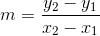
The coordinates of the first end of the plank would be (0,3), given that this is the starting point of the plank (so x would be 0), and y would be 3 since the brick is 3 inches tall.
The coordinates of the second end of the plank would be (18,9) since the plank is 18 inches long (so x would be 18) and y would be 9 since the box was 9 inches tall at the other end.
From this information we know that we can assign the following coordinates for the equation:
 and
and 
Below is the solution we would get from plugging this information into the equation for slope:

This reduces to 
The value of the slope (m) is rise over run, and can be calculated with the formula below:
The coordinates of the first end of the plank would be (0,3), given that this is the starting point of the plank (so x would be 0), and y would be 3 since the brick is 3 inches tall.
The coordinates of the second end of the plank would be (18,9) since the plank is 18 inches long (so x would be 18) and y would be 9 since the box was 9 inches tall at the other end.
From this information we know that we can assign the following coordinates for the equation:
Below is the solution we would get from plugging this information into the equation for slope:
This reduces to
Give the slope of a line that passes through  and
and  .
.
Give the slope of a line that passes through
Tap to see back →
Using the slope formula, substituting  ,
,  ,
,  , and
, and  :
:


Subtract to get:

Cancel out the negative signs to get:

Using the slope formula, substituting
Subtract to get:
Cancel out the negative signs to get:
Give the slope of a line that passes through  and
and  .
.
Give the slope of a line that passes through
Tap to see back →
Using the slope formula with  ,
,  ,
,  ,
,  :
:


Subtract to get:

Using the slope formula with
Subtract to get:
Give the slope of the line that passes through  and
and  .
.
Give the slope of the line that passes through
Tap to see back →
Using the slope formula for
 ,
,  ,
,  , and
, and  :
:


Combine the negative signs to get:

Subtract and add to get:

Reduce to get:

Using the slope formula for
Combine the negative signs to get:
Subtract and add to get:
Reduce to get:
Give the slope of a line that passes through  and
and  .
.
Give the slope of a line that passes through
Tap to see back →
Using the slope formula, where  is the slope,
 , and
, and 
 :
:


Using the slope formula, where
Find the slope of a line with points  and
and  .
.
Find the slope of a line with points
Tap to see back →
Using the slope formula, where  is the slope,
 , and
, and 
 :
:


Using the slope formula, where
Find the slope of the line that passes through the points  and
and 
Find the slope of the line that passes through the points
Tap to see back →
Using the slope formula, where  is the slope,
 , and
, and 
 :
:


Using the slope formula, where
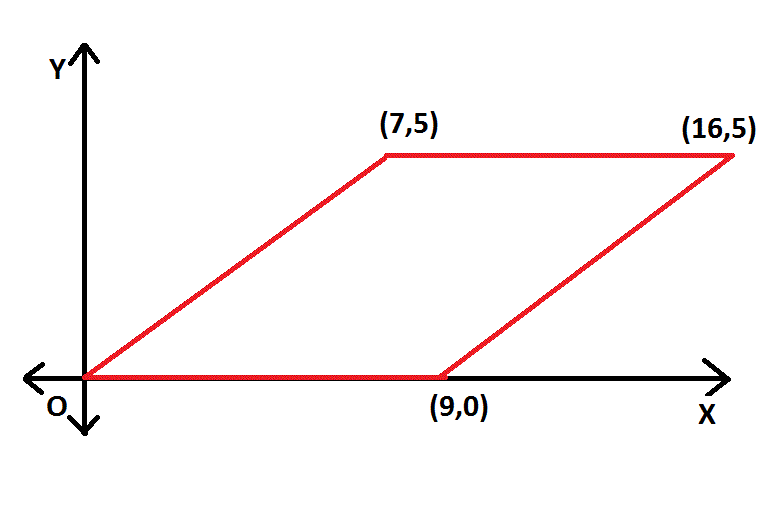
NOTE: Figure NOT drawn to scale.
What is the area of the parallelogram represented by the above figure?
NOTE: Figure NOT drawn to scale.
What is the area of the parallelogram represented by the above figure?
Tap to see back →
The area of a parallelogram is its base multiplied by its height. The diagram below shows both in green:
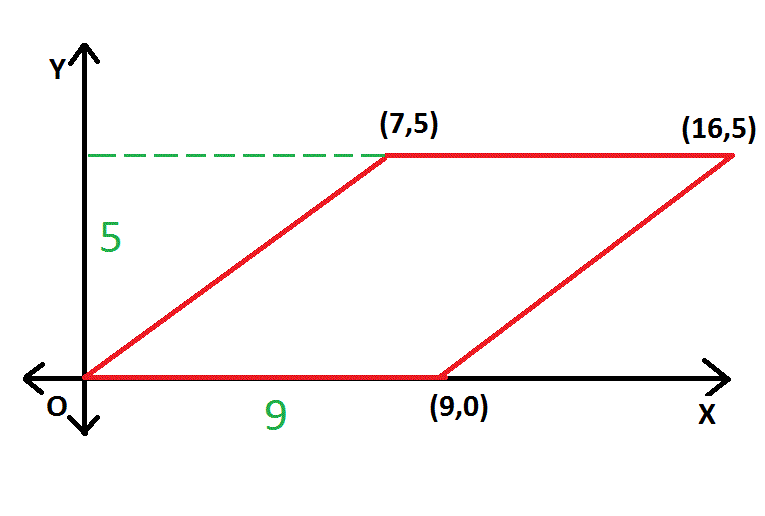

The area of a parallelogram is its base multiplied by its height. The diagram below shows both in green:
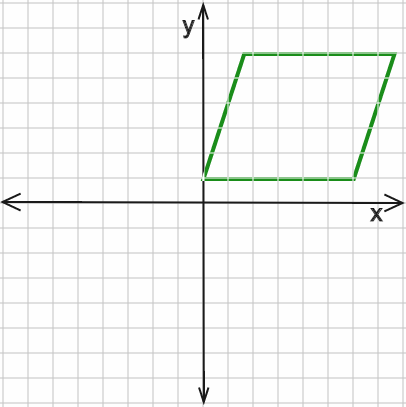
Find the area of the above parallelogram given a height of 5 units, as shown to scale.
Find the area of the above parallelogram given a height of 5 units, as shown to scale.
Tap to see back →
Since the diagram is drawn to scale, the base of the parallelogram must be 6 units in length. Using the area formula for a parallelogram:

Since the diagram is drawn to scale, the base of the parallelogram must be 6 units in length. Using the area formula for a parallelogram:
Given a base of 12 units and an area of 120 square units, find the height of the paralellogram shown above.
Given a base of 12 units and an area of 120 square units, find the height of the paralellogram shown above.
Tap to see back →
The area formula for a parallelogram is:

Thus, to find the height, rearrange:

The area formula for a parallelogram is:
Thus, to find the height, rearrange:
The above parallelogram has an area of 30 square units. Which of the following could be the lengths of the base and height of this figure? (Image not drawn to scale.)
The above parallelogram has an area of 30 square units. Which of the following could be the lengths of the base and height of this figure? (Image not drawn to scale.)
Tap to see back →
The formula for the area of a parallelogram is:

Thus, the base and height must equal 30 square units when multiplied together.
3 and 10 are the only combination of base and height which, when multiplied, equal the area of 30 square units.
The formula for the area of a parallelogram is:
Thus, the base and height must equal 30 square units when multiplied together.
3 and 10 are the only combination of base and height which, when multiplied, equal the area of 30 square units.
Dr. Robinson recently put a rectangular fence around his backyard. The fence has a width of  yards and a length of
  yards. If Dr. Robinson paid
  for every yard of fence, how much did the fence cost?
Dr. Robinson recently put a rectangular fence around his backyard. The fence has a width of
Tap to see back →
To find the cost of the fence, apply the formula  in order to first find the length of the perimeter of the fence.
Then multiply the perimeter by  .
.
Thus, the solution is:




To find the cost of the fence, apply the formula
Then multiply the perimeter by
Thus, the solution is:
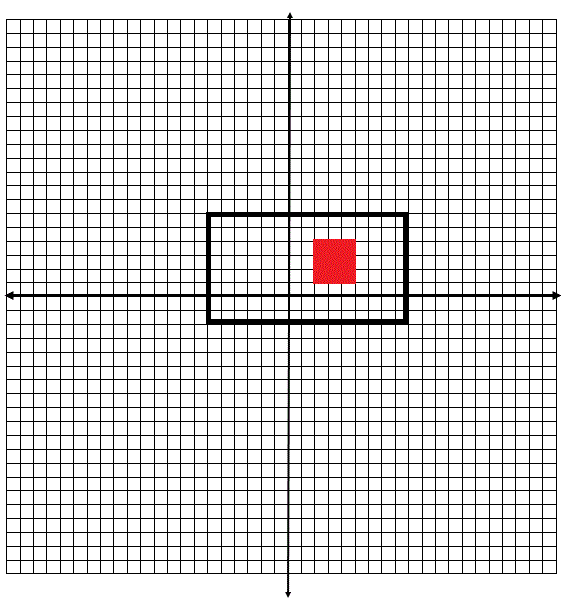
In the above figure Dr. Robinson's shed is represented by the red square, and the shed has a perimeter of  yards. Find how much area Dr. Robinson has in his backyard--excluding the area that the shed occupies.
In the above figure Dr. Robinson's shed is represented by the red square, and the shed has a perimeter of
Tap to see back →
To find how much area Dr. Robinson has around his shed in his backyard, first apply the formula:  , where
  represents one side of the red shed. Given that
 must equal
  because
  .
.
Now you have enough information to find the area of the red shed.
Apply the formula: 

Since the rectangular fence has a width of  yards and a length of
  yards, apply the formula:
  in order to find the area of the entire backyard.
Thus,

Then simply find the difference between the area of the entire yard and the area of the shed.
Thus the final solution is:

To find how much area Dr. Robinson has around his shed in his backyard, first apply the formula:
Now you have enough information to find the area of the red shed.
Apply the formula:
Since the rectangular fence has a width of
Thus,
Then simply find the difference between the area of the entire yard and the area of the shed.
Thus the final solution is:
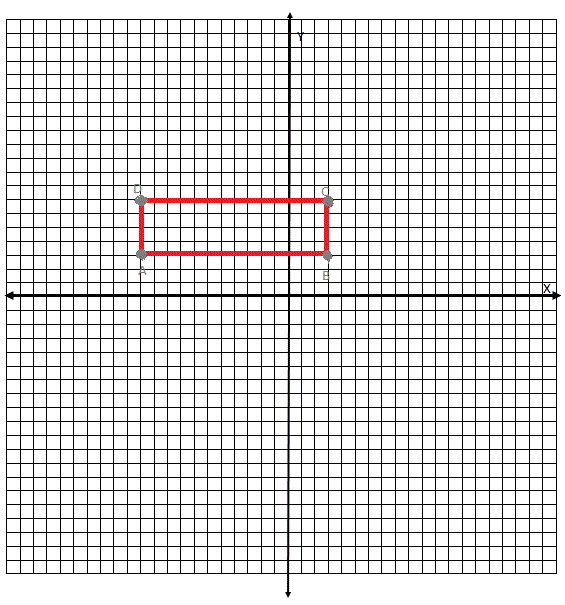
Identify the correct set of coordinates for rectangle  .
.
Identify the correct set of coordinates for rectangle
Tap to see back →
To identify the correct set of coordinate points for rectangle  , note that the correct set must have two sets of matching
  coordinates and two sets of matching
  coordinates. The only answer choice that meets these specifications is:
To identify the correct set of coordinate points for rectangle
The rectangle shown above has a width of  and a length of
  . Find the area and perimeter of the rectangle.
The rectangle shown above has a width of
Tap to see back →
To solve this problem apply the formulas:  &
& 
Thus, the solution is:


To solve this problem apply the formulas:
Thus, the solution is:
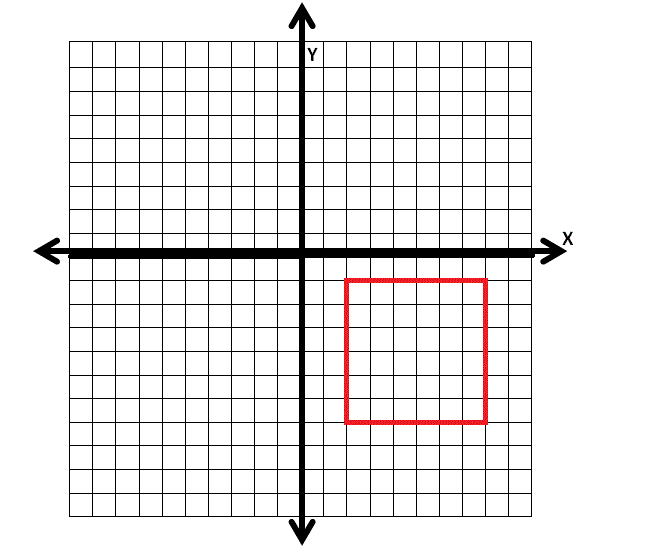
Find the area of the above square.
Find the area of the above square.
Tap to see back →
In order to find the area of the square above apply the formula:  , where
  the length of one side of the square.
Since  ,
,
the solution is 
In order to find the area of the square above apply the formula:
Since
the solution is
Find the perimeter of the square shown above.
Find the perimeter of the square shown above.
Tap to see back →
To find the perimeter of this square, apply the formula:  , where
  the length of one side of the square.
Thus, the solution is:


To find the perimeter of this square, apply the formula:
Thus, the solution is:
If a square has an area of  square units, what is the perimeter?
If a square has an area of
Tap to see back →
In order to solve this problem, apply the formula  , in order to conclude that the length of side
  must equal
  for the area to equal
  .
.
Once you've found the length of side  , apply the formula
  .
.
Thus, the solution is 
In order to solve this problem, apply the formula
Once you've found the length of side
Thus, the solution is
A square has an area of  square units, what is the perimeter?
A square has an area of
Tap to see back →
In order to solve this problem, apply the formula  , in order to conclude that the length of side
  must equal
  for the area to equal
  .
.
Once you've found the length of side  , apply the formula

In order to solve this problem, apply the formula
Once you've found the length of side