How to find a line on a coordinate plane - SSAT Middle Level Quantitative
Card 0 of 32
Give the slope of the line that passes through  and
and  .
.
Give the slope of the line that passes through
Tap to see back →
Use the slope formula, substituting  :
:

Use the slope formula, substituting
Billy set up a ramp for his toy cars. He did this by taking a wooden plank and putting one end on top of a brick that was 3 inches high. He then put the other end on top of a box that was 9 inches high. The bricks were 18 inches apart. What is the slope of the plank?
Billy set up a ramp for his toy cars. He did this by taking a wooden plank and putting one end on top of a brick that was 3 inches high. He then put the other end on top of a box that was 9 inches high. The bricks were 18 inches apart. What is the slope of the plank?
Tap to see back →
The value of the slope (m) is rise over run, and can be calculated with the formula below:
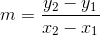
The coordinates of the first end of the plank would be (0,3), given that this is the starting point of the plank (so x would be 0), and y would be 3 since the brick is 3 inches tall.
The coordinates of the second end of the plank would be (18,9) since the plank is 18 inches long (so x would be 18) and y would be 9 since the box was 9 inches tall at the other end.
From this information we know that we can assign the following coordinates for the equation:
 and
and 
Below is the solution we would get from plugging this information into the equation for slope:

This reduces to 
The value of the slope (m) is rise over run, and can be calculated with the formula below:
The coordinates of the first end of the plank would be (0,3), given that this is the starting point of the plank (so x would be 0), and y would be 3 since the brick is 3 inches tall.
The coordinates of the second end of the plank would be (18,9) since the plank is 18 inches long (so x would be 18) and y would be 9 since the box was 9 inches tall at the other end.
From this information we know that we can assign the following coordinates for the equation:
Below is the solution we would get from plugging this information into the equation for slope:
This reduces to
Give the slope of a line that passes through  and
and  .
.
Give the slope of a line that passes through
Tap to see back →
Using the slope formula, substituting  ,
,  ,
,  , and
, and  :
:


Subtract to get:

Cancel out the negative signs to get:

Using the slope formula, substituting
Subtract to get:
Cancel out the negative signs to get:
Give the slope of a line that passes through  and
and  .
.
Give the slope of a line that passes through
Tap to see back →
Using the slope formula with  ,
,  ,
,  ,
,  :
:


Subtract to get:

Using the slope formula with
Subtract to get:
Give the slope of the line that passes through  and
and  .
.
Give the slope of the line that passes through
Tap to see back →
Using the slope formula for
 ,
,  ,
,  , and
, and  :
:


Combine the negative signs to get:

Subtract and add to get:

Reduce to get:

Using the slope formula for
Combine the negative signs to get:
Subtract and add to get:
Reduce to get:
Give the slope of a line that passes through  and
and  .
.
Give the slope of a line that passes through
Tap to see back →
Using the slope formula, where  is the slope,
 , and
, and 
 :
:


Using the slope formula, where
Find the slope of a line with points  and
and  .
.
Find the slope of a line with points
Tap to see back →
Using the slope formula, where  is the slope,
 , and
, and 
 :
:


Using the slope formula, where
Find the slope of the line that passes through the points  and
and 
Find the slope of the line that passes through the points
Tap to see back →
Using the slope formula, where  is the slope,
 , and
, and 
 :
:


Using the slope formula, where
Give the slope of the line that passes through and .
Give the slope of the line that passes through
Tap to see back →
Use the slope formula, substituting :
Use the slope formula, substituting
Billy set up a ramp for his toy cars. He did this by taking a wooden plank and putting one end on top of a brick that was 3 inches high. He then put the other end on top of a box that was 9 inches high. The bricks were 18 inches apart. What is the slope of the plank?
Billy set up a ramp for his toy cars. He did this by taking a wooden plank and putting one end on top of a brick that was 3 inches high. He then put the other end on top of a box that was 9 inches high. The bricks were 18 inches apart. What is the slope of the plank?
Tap to see back →
The value of the slope (m) is rise over run, and can be calculated with the formula below:
The coordinates of the first end of the plank would be (0,3), given that this is the starting point of the plank (so x would be 0), and y would be 3 since the brick is 3 inches tall.
The coordinates of the second end of the plank would be (18,9) since the plank is 18 inches long (so x would be 18) and y would be 9 since the box was 9 inches tall at the other end.
From this information we know that we can assign the following coordinates for the equation:
and
Below is the solution we would get from plugging this information into the equation for slope:
This reduces to
The value of the slope (m) is rise over run, and can be calculated with the formula below:
The coordinates of the first end of the plank would be (0,3), given that this is the starting point of the plank (so x would be 0), and y would be 3 since the brick is 3 inches tall.
The coordinates of the second end of the plank would be (18,9) since the plank is 18 inches long (so x would be 18) and y would be 9 since the box was 9 inches tall at the other end.
From this information we know that we can assign the following coordinates for the equation:
Below is the solution we would get from plugging this information into the equation for slope:
This reduces to
Give the slope of a line that passes through and .
Give the slope of a line that passes through
Tap to see back →
Using the slope formula, substituting , , , and :
Subtract to get:
Cancel out the negative signs to get:
Using the slope formula, substituting
Subtract to get:
Cancel out the negative signs to get:
Give the slope of a line that passes through and .
Give the slope of a line that passes through
Tap to see back →
Using the slope formula with , , , :
Subtract to get:
Using the slope formula with
Subtract to get:
Give the slope of the line that passes through and .
Give the slope of the line that passes through
Tap to see back →
Using the slope formula for
, , , and :
Combine the negative signs to get:
Subtract and add to get:
Reduce to get:
Using the slope formula for
Combine the negative signs to get:
Subtract and add to get:
Reduce to get:
Give the slope of a line that passes through and .
Give the slope of a line that passes through
Tap to see back →
Using the slope formula, where is the slope, , and :
Using the slope formula, where
Find the slope of a line with points and .
Find the slope of a line with points
Tap to see back →
Using the slope formula, where is the slope, , and :
Using the slope formula, where
Find the slope of the line that passes through the points and
Find the slope of the line that passes through the points
Tap to see back →
Using the slope formula, where is the slope, , and :
Using the slope formula, where
Give the slope of the line that passes through and .
Give the slope of the line that passes through
Tap to see back →
Use the slope formula, substituting :
Use the slope formula, substituting
Billy set up a ramp for his toy cars. He did this by taking a wooden plank and putting one end on top of a brick that was 3 inches high. He then put the other end on top of a box that was 9 inches high. The bricks were 18 inches apart. What is the slope of the plank?
Billy set up a ramp for his toy cars. He did this by taking a wooden plank and putting one end on top of a brick that was 3 inches high. He then put the other end on top of a box that was 9 inches high. The bricks were 18 inches apart. What is the slope of the plank?
Tap to see back →
The value of the slope (m) is rise over run, and can be calculated with the formula below:
The coordinates of the first end of the plank would be (0,3), given that this is the starting point of the plank (so x would be 0), and y would be 3 since the brick is 3 inches tall.
The coordinates of the second end of the plank would be (18,9) since the plank is 18 inches long (so x would be 18) and y would be 9 since the box was 9 inches tall at the other end.
From this information we know that we can assign the following coordinates for the equation:
and
Below is the solution we would get from plugging this information into the equation for slope:
This reduces to
The value of the slope (m) is rise over run, and can be calculated with the formula below:
The coordinates of the first end of the plank would be (0,3), given that this is the starting point of the plank (so x would be 0), and y would be 3 since the brick is 3 inches tall.
The coordinates of the second end of the plank would be (18,9) since the plank is 18 inches long (so x would be 18) and y would be 9 since the box was 9 inches tall at the other end.
From this information we know that we can assign the following coordinates for the equation:
Below is the solution we would get from plugging this information into the equation for slope:
This reduces to
Give the slope of a line that passes through and .
Give the slope of a line that passes through
Tap to see back →
Using the slope formula, substituting , , , and :
Subtract to get:
Cancel out the negative signs to get:
Using the slope formula, substituting
Subtract to get:
Cancel out the negative signs to get:
Give the slope of a line that passes through and .
Give the slope of a line that passes through
Tap to see back →
Using the slope formula with , , , :
Subtract to get:
Using the slope formula with
Subtract to get: