How to find length of a line - SSAT Middle Level Quantitative
Card 0 of 52
The radius of a circle is 6 inches. What is one-third of the diameter?
The radius of a circle is 6 inches. What is one-third of the diameter?
Tap to see back →
If the radius is equal to 6 inches, then the diameter will be double that value, or 12 inches. One-third of 12 is 4, which is therefore the correct answer.
If the radius is equal to 6 inches, then the diameter will be double that value, or 12 inches. One-third of 12 is 4, which is therefore the correct answer.
If a circle has a radius of 12 inches, the biggest line that would be drawn within the circle is:
If a circle has a radius of 12 inches, the biggest line that would be drawn within the circle is:
Tap to see back →
The largest line that can be drawn within a circle is the diamater. The diameter is equal to twice the radius. Given that the radius is equal to 12 inches, the largest line that could be drawn (the diameter) would be equal to 24 inches.
The largest line that can be drawn within a circle is the diamater. The diameter is equal to twice the radius. Given that the radius is equal to 12 inches, the largest line that could be drawn (the diameter) would be equal to 24 inches.
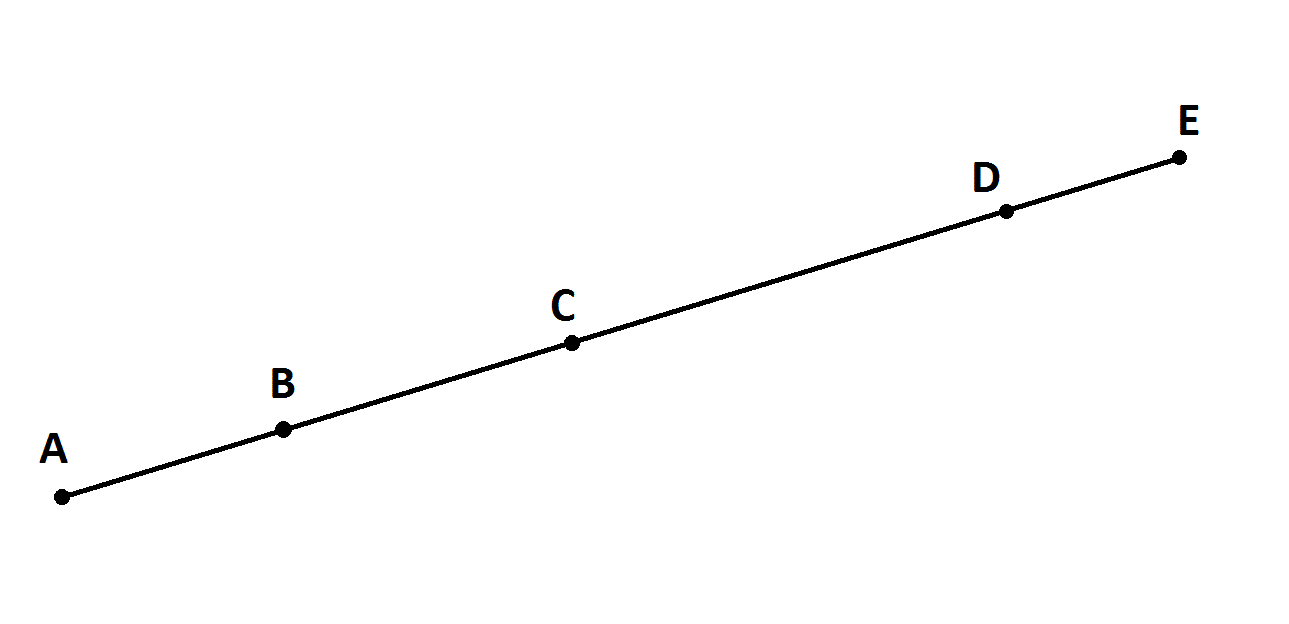
Figure NOT drawn to scale.

Evaluate  .
.
Figure NOT drawn to scale.
Evaluate
Tap to see back →
By the Segment Addition Postulate,


By the Segment Addition Postulate,
Figure NOT drawn to scale.

Evaluate  .
.
Figure NOT drawn to scale.
Evaluate
Tap to see back →
By the Segment Addition Postulate,


By the Segment Addition Postulate,
What is the length of a line segment with end points  and
and  ?
?
What is the length of a line segment with end points
Tap to see back →
The length of a line segment can be determined using the distance formula:




The length of a line segment can be determined using the distance formula:
What is the length of a line with endpoints  and
and  .
.
What is the length of a line with endpoints
Tap to see back →
To find the length of this line, you can subtract  to get
  . Since the y-coordinates are the same, you don't have to take any vertical direction into account. Therefore, you only look at the x-coordinates!
To find the length of this line, you can subtract
Find the length of the line segment whose endpoints are  and
and  .
.
Find the length of the line segment whose endpoints are
Tap to see back →
We can use the distance formula:


We can use the distance formula:
The point  lies on a circle. What is the length of the radius of the circle if the center is located at
  ?
?
The point
Tap to see back →
The radius is the distance from the center of the circle to anypoint on the circle. So we can use the distance formula in order to find the radius of the circle:


The radius is the distance from the center of the circle to anypoint on the circle. So we can use the distance formula in order to find the radius of the circle:
The coordinates of  and
and  are
are  and
and  . Find the length of the diagonal of the following rectangle:

The coordinates of
Tap to see back →
A rectangle has two diagonals with the same length. So we should find the length of  . We can use the distance formula:


A rectangle has two diagonals with the same length. So we should find the length of
A right triangle has one leg with a length of 6 feet and a hypotenuse of 10 feet. What is the length of the other leg?
A right triangle has one leg with a length of 6 feet and a hypotenuse of 10 feet. What is the length of the other leg?
Tap to see back →
In geometry, a right angle triangle can occur with the ratio of  in which 3 and 4 are each leg lengths, and 5 is the hypotenuse.
When you know the length of two sides of a right angle triangle like this, you can calculate the third side using this ratio.
Here, the ratio is:

This is double the  ratio. Therefore, we should multiply 4 by 2 in order to solve for the missing leg, which would be a value of 8 feet.
Another way to solve is to use the Pythagorean Theorem:  .
.
We know that one leg is 6 feet and the hypotenuse is 10 feet.


In geometry, a right angle triangle can occur with the ratio of
When you know the length of two sides of a right angle triangle like this, you can calculate the third side using this ratio.
Here, the ratio is:
This is double the
Another way to solve is to use the Pythagorean Theorem:
We know that one leg is 6 feet and the hypotenuse is 10 feet.
The diameter of a circle is  centimeters. What is one-fourth of the circle's radius?
The diameter of a circle is
Tap to see back →
By definition, the radius  and diameter
  of a circle are related by the following equation:

Plugging in  as stated in the question, we find that
  .
.
Since the question is asking us for the value of  :
:
 .
.
By definition, the radius
Plugging in
Since the question is asking us for the value of
A right triangle has one leg with length  and another leg with length
  . What is the length of the hypotenuse?
A right triangle has one leg with length
Tap to see back →
Since we are dealing with a right triangle, we can use the Pythagorean Theorem:
 ,
,
where  and
and  are leg lengths of
  and
and  , respectively, and
  is the length of the hypotenuse.
Substituting values into the Theorem:


Since we are dealing with a right triangle, we can use the Pythagorean Theorem:
where
Substituting values into the Theorem:
Line  has a length of
  . It is bisected at point
  , and the resulting segment
  is bisected again at point
  . What is the length of the line segment
  ?
?
Line
Tap to see back →
A line that is bisected is split into two segments of equal length. Therefore, if line  is bisected at point
  ,
,
 .
.
Consequently, bisecting line segment  at point
  :
:

A line that is bisected is split into two segments of equal length. Therefore, if line
Consequently, bisecting line segment
The radius of a circle is 6 inches. What is one-third of the diameter?
The radius of a circle is 6 inches. What is one-third of the diameter?
Tap to see back →
If the radius is equal to 6 inches, then the diameter will be double that value, or 12 inches. One-third of 12 is 4, which is therefore the correct answer.
If the radius is equal to 6 inches, then the diameter will be double that value, or 12 inches. One-third of 12 is 4, which is therefore the correct answer.
If a circle has a radius of 12 inches, the biggest line that would be drawn within the circle is:
If a circle has a radius of 12 inches, the biggest line that would be drawn within the circle is:
Tap to see back →
The largest line that can be drawn within a circle is the diamater. The diameter is equal to twice the radius. Given that the radius is equal to 12 inches, the largest line that could be drawn (the diameter) would be equal to 24 inches.
The largest line that can be drawn within a circle is the diamater. The diameter is equal to twice the radius. Given that the radius is equal to 12 inches, the largest line that could be drawn (the diameter) would be equal to 24 inches.
Figure NOT drawn to scale.
Evaluate .
Figure NOT drawn to scale.
Evaluate
Tap to see back →
By the Segment Addition Postulate,
By the Segment Addition Postulate,
Figure NOT drawn to scale.
Evaluate .
Figure NOT drawn to scale.
Evaluate
Tap to see back →
By the Segment Addition Postulate,
By the Segment Addition Postulate,
What is the length of a line segment with end points and ?
What is the length of a line segment with end points
Tap to see back →
The length of a line segment can be determined using the distance formula:
The length of a line segment can be determined using the distance formula:
What is the length of a line with endpoints and .
What is the length of a line with endpoints
Tap to see back →
To find the length of this line, you can subtract to get . Since the y-coordinates are the same, you don't have to take any vertical direction into account. Therefore, you only look at the x-coordinates!
To find the length of this line, you can subtract
Find the length of the line segment whose endpoints are and .
Find the length of the line segment whose endpoints are
Tap to see back →
We can use the distance formula:
We can use the distance formula: