How to find the perimeter of a rectangle - SSAT Middle Level Quantitative
Card 0 of 80
What is the perimeter of a rectangle with a width of 3 and a length of 10?
What is the perimeter of a rectangle with a width of 3 and a length of 10?
Tap to see back →
The formula for the perimeter of a rectangle is Perimeter=2l+2w.
Plug in our given values to solve:
Perimeter = 2(20)+2(3)
Perimeter = 20+6
Perimeter = 26
The formula for the perimeter of a rectangle is Perimeter=2l+2w.
Plug in our given values to solve:
Perimeter = 2(20)+2(3)
Perimeter = 20+6
Perimeter = 26
Rectangle ABCD has an area of  . If the width of the rectangle is
  , what is the perimeter?
Rectangle ABCD has an area of
Tap to see back →
The area of a rectangle is found by multiplying the length times the width. The question tells you the width is  and the area is
  .
.
Thus the length is 8.  .
.
To find the perimeter you add up all of the sides.


The area of a rectangle is found by multiplying the length times the width. The question tells you the width is
Thus the length is 8.
To find the perimeter you add up all of the sides.
The width of a rectangle is half of its length. If the width is given as _ _what is the perimeter of the rectangle in terms of
  ?
?
The width of a rectangle is half of its length. If the width is given as _
Tap to see back →
The sum of the widths is _ _and since the width is half the length, each length is
  . Since there are 2 lengths we get a total perimeter of
  .
.
The sum of the widths is _
How many meters of fence are needed to enclose a rectangular field that has a length of 1000 meters and a width of 100 meters?
How many meters of fence are needed to enclose a rectangular field that has a length of 1000 meters and a width of 100 meters?
Tap to see back →
The perimeter of a rectangle is simply the sum of the four sides:

The perimeter of a rectangle is simply the sum of the four sides:

The above figure shows the size and shape of a yard that is to be surrounded by some fence. How many feet of fence will be needed?
Note: all sides meet at right angles.
The above figure shows the size and shape of a yard that is to be surrounded by some fence. How many feet of fence will be needed?
Note: all sides meet at right angles.
Tap to see back →
The best way to see that 750 feet of fence are needed is to look at this augmented diagram.
Note that two of the sides are extended to form a smaller rectangle whose sides can be deduced by subtraction. Since opposite sides of a rectangle are congruent, this allows us to fill in the two missing sidelengths of the original figure.

Now add: 
The best way to see that 750 feet of fence are needed is to look at this augmented diagram.
Note that two of the sides are extended to form a smaller rectangle whose sides can be deduced by subtraction. Since opposite sides of a rectangle are congruent, this allows us to fill in the two missing sidelengths of the original figure.
Now add:

Give the perimeter of the rectangle in the above diagram.
Give the perimeter of the rectangle in the above diagram.
Tap to see back →
The perimeter of a rectangle is the sum of the length and the width, multiplied by 2:

The rectangle has a perimeter of 38 centimeters.
The perimeter of a rectangle is the sum of the length and the width, multiplied by 2:
The rectangle has a perimeter of 38 centimeters.

Give the perimeter of the rectangle in the above diagram.
Give the perimeter of the rectangle in the above diagram.
Tap to see back →
The perimeter of a rectangle can be calculated by multiplying two by the sum of the length and width of the rectangle.


The perimeter of the rectangle is  inches.
The perimeter of a rectangle can be calculated by multiplying two by the sum of the length and width of the rectangle.
The perimeter of the rectangle is
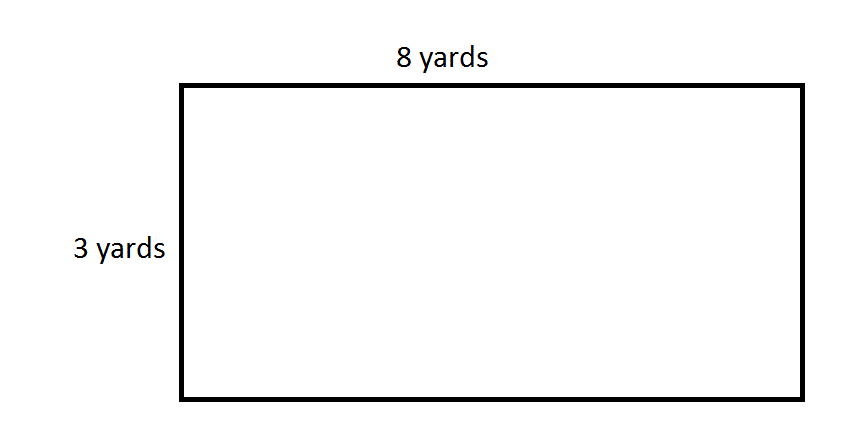
Give the perimeter of the above rectangle in centimeters, using the conversion factor  centimeters per yard.
Give the perimeter of the above rectangle in centimeters, using the conversion factor
Tap to see back →
The perimeter of the rectangle is  yards. To convert this to centimeters, multiply by the given conversion factor:
 centimeters.
The perimeter of the rectangle is
A rectangle has an area of  . The length of each side is a whole number. What is NOT a possible value for the rectangle's perimeter?
A rectangle has an area of
Tap to see back →
Since each side is a whole number, first find the whole number factors of  . They are
  and
and  ,
,  and
and  ,
,  and
and  , and
, and  and
and  . These sidelengths correspond to perimeters of
  ,
,  ,
,  , and
, and  , respectively. Thus,
  is answer.
Since each side is a whole number, first find the whole number factors of
You are given equilateral triangle  and Rectangle
with  .
.
What is the perimeter of Rectangle  ?
?
You are given equilateral triangle
with
What is the perimeter of Rectangle
Tap to see back →
is equilateral, so  .
.
Also, since opposite sides of a rectangle are congruent,
 and
and 
The perimeter of Rectangle  is
is

Also, since opposite sides of a rectangle are congruent,
The perimeter of Rectangle
The length of a rectangle is two times as long as the width. The width is equal to  inches. What is the perimeter of the rectangle?
The length of a rectangle is two times as long as the width. The width is equal to
Tap to see back →


A hectare is a unit of area equal to 10,000 square meters.
A 150-hectare plot of land is rectangular and is 1.2 kilometers in width. Give the perimeter of this land.
A hectare is a unit of area equal to 10,000 square meters.
A 150-hectare plot of land is rectangular and is 1.2 kilometers in width. Give the perimeter of this land.
Tap to see back →
150 hectares is equal to  square meters.
The width of this land is 1.2 kilometers, or  meters. Divide the area by the width to get:
 meters
The perimeter of the land is
 meters, or
  kilometers.
150 hectares is equal to
The width of this land is 1.2 kilometers, or
The perimeter of the land is
The perimeter of a rectangle with a length of  and a width of
  is
is  . Find
  .
.
The perimeter of a rectangle with a length of
Tap to see back →
We know that:

where:


So we can write:

We know that:
where:
So we can write:
The width of a rectangle is  , the length is
  , and the perimeter is 72. What is the value of
  ?
?
The width of a rectangle is
Tap to see back →
Start with the equation for the perimeter of a rectangle:

We know the perimeter is 72, the length is  , and the width is
  . Plug these values into our equation.

Multiply and combine like terms.


Divide by 18 to isolate the variable.

Simplify the fraction by removing the common factor.

Start with the equation for the perimeter of a rectangle:
We know the perimeter is 72, the length is
Multiply and combine like terms.
Divide by 18 to isolate the variable.
Simplify the fraction by removing the common factor.
If the perimeter of a rectangle is  inches and the width is
  inches, what is the length?
If the perimeter of a rectangle is
Tap to see back →
The perimeter of a rectangle is represented by the following formula, in which W represents width and L represents length:

Given that the width is  inches and that the perimeter is
  inches, the following applies:


Next, subtract  from each side.

Now, divide each side by  .
.
This gives us

The perimeter of a rectangle is represented by the following formula, in which W represents width and L represents length:
Given that the width is
Next, subtract
Now, divide each side by
This gives us
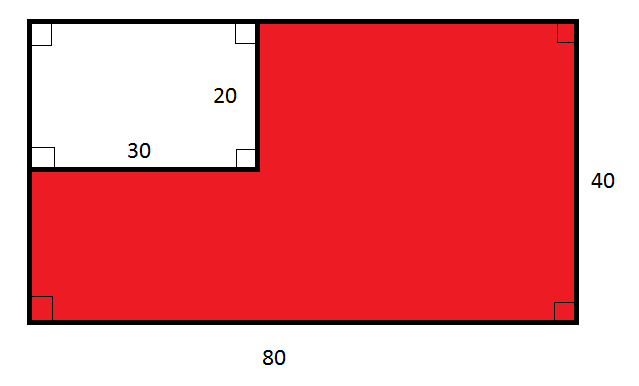
Note: Figure NOT drawn to scale.
Refer to the above diagram. Give the perimeter of the red polygon.
Note: Figure NOT drawn to scale.
Refer to the above diagram. Give the perimeter of the red polygon.
Tap to see back →
Since opposite sides of a rectangle have the same measure, the missing sidelengths can be calculated as in the diagram below:

The sidelengths of the red polygon can now be added to find the perimeter:

Since opposite sides of a rectangle have the same measure, the missing sidelengths can be calculated as in the diagram below:
The sidelengths of the red polygon can now be added to find the perimeter:
Note: Figure NOT drawn to scale.
Refer to the above diagram. Give the ratio of the perimeter of the large rectangle to that of the smaller rectangle.
Note: Figure NOT drawn to scale.
Refer to the above diagram. Give the ratio of the perimeter of the large rectangle to that of the smaller rectangle.
Tap to see back →
Opposite sides of a rectangle are congruent.
The large rectangle has perimeter
 .
.
The smaller rectangle has perimeter
 .
.
The ratio is
 ; that is, 12 to 5.
Opposite sides of a rectangle are congruent.
The large rectangle has perimeter
The smaller rectangle has perimeter
The ratio is

Figure NOT drawn to scale.
Give the perimeter of the green polygon in the above figure.
Figure NOT drawn to scale.
Give the perimeter of the green polygon in the above figure.
Tap to see back →
Since opposite sides of a rectangle have the same measure, the missing sidelengths can be calculated as in the diagram below:

The sidelengths of the green polygon can now be added to find the perimeter:

Since opposite sides of a rectangle have the same measure, the missing sidelengths can be calculated as in the diagram below:
The sidelengths of the green polygon can now be added to find the perimeter:
The width of a rectangle is one-third of its length. If the width is given as  what is the perimeter of the rectangle in terms of
  ?
?
The width of a rectangle is one-third of its length. If the width is given as
Tap to see back →
The perimeter of a rectangle is the sum of its sides.
The sum of the widths is  and since the width is one-third of the length, each length is
  . Since there are
  lengths we get a total of
  . Widths + lengths =
The perimeter of a rectangle is the sum of its sides.
The sum of the widths is
Find the perimeter of the rectangle shown below

Find the perimeter of the rectangle shown below
Tap to see back →
The perimeter of a rectangle, or any shape, is the distance around the outside. You add up the length of each side to find this number. The coordinates of the points are  . You need to find the distance between each point. The short side is
  units, and the longer side is
  units.

The perimeter of a rectangle, or any shape, is the distance around the outside. You add up the length of each side to find this number. The coordinates of the points are