How to multiply fractions - SSAT Middle Level Quantitative
Card 0 of 1216
Fill in the blank with the correct sign.


Fill in the blank with the correct sign.
Tap to see back →


When we multiply a fraction by a whole number, we first want to make the whole number into a fraction. We do that by putting the whole number over  Then we multiply like normal.

 Because
  can go into
  only
only  time and
  is left over.

When we multiply a fraction by a whole number, we first want to make the whole number into a fraction. We do that by putting the whole number over
Fill in the blank with the correct sign.


Fill in the blank with the correct sign.
Tap to see back →


When we multiply a fraction by a whole number, we first want to make the whole number into a fraction. We do that by putting the whole number over  Then we multiply like normal.

 Because
  can go into
  an even
  time.
time.

When we multiply a fraction by a whole number, we first want to make the whole number into a fraction. We do that by putting the whole number over
Fill in the blank with the correct sign.


Fill in the blank with the correct sign.
Tap to see back →


When we multiply a fraction by a whole number, we first want to make the whole number into a fraction. We do that by putting the whole number over  Then we multiply like normal.

 Because
  can go into
  and even
  times.

When we multiply a fraction by a whole number, we first want to make the whole number into a fraction. We do that by putting the whole number over
Evaluate:

Evaluate:
Tap to see back →
By order of operations, perform the rightmost addition (the one within the parentheses) first, the multiplication second. and the leftmost addition last.

By order of operations, perform the rightmost addition (the one within the parentheses) first, the multiplication second. and the leftmost addition last.
Express the product in simplest form:

Express the product in simplest form:
Tap to see back →
Rewrite the mixed fractions as improper fractions, cross-cancel, and multiply across:

Rewrite the mixed fractions as improper fractions, cross-cancel, and multiply across:
Evaluate:

Evaluate:
Tap to see back →
By order of operations, multiply first:

Multiply 14 by 16, and position the decimal point so that two digits are right of it:


Now add this product to 6.5:

Append a zero to the 6.5, and align the decimal points:


By order of operations, multiply first:
Multiply 14 by 16, and position the decimal point so that two digits are right of it:
Now add this product to 6.5:
Append a zero to the 6.5, and align the decimal points:
Evaluate:

Evaluate:
Tap to see back →
By order of operations, multiply first:

Multiply 32 by 15, and position the decimal point so that two digits are right of it:


Now add this product to 5.96:

Append a zero to the 4.8, and align the decimal points:


By order of operations, multiply first:
Multiply 32 by 15, and position the decimal point so that two digits are right of it:
Now add this product to 5.96:
Append a zero to the 4.8, and align the decimal points:
Evaluate:

Evaluate:
Tap to see back →
The product of two numbers of unlike sign is the (negative) opposite of the product of their absolute values.

There are a total of two digits to the right of the two decimal points. Therefore, the product can be calculated by multiplying 201 by 203, then placing the decimal point so that there are three digits at right.

Since we need to affix a negative symbol in front, the answer is 
The product of two numbers of unlike sign is the (negative) opposite of the product of their absolute values.
There are a total of two digits to the right of the two decimal points. Therefore, the product can be calculated by multiplying 201 by 203, then placing the decimal point so that there are three digits at right.
Since we need to affix a negative symbol in front, the answer is

Tap to see back →
When multiplying a fraction, simply multiply straight across - numerator times numerator, denominator times denominator. When you do that, you should get this answer:

Do not forget to reduce. 3 and 30 can both be evenly divided by 3, which would give you  as your answer.
When multiplying a fraction, simply multiply straight across - numerator times numerator, denominator times denominator. When you do that, you should get this answer:
Do not forget to reduce. 3 and 30 can both be evenly divided by 3, which would give you
One euro is worth approximately $1.27. For how much American money can a French tourist expect to exchange 800 euros?
One euro is worth approximately $1.27. For how much American money can a French tourist expect to exchange 800 euros?
Tap to see back →
One Euro is equivalent to $1.27, so multiply the number of euros - 800 - by this conversion factor.

One Euro is equivalent to $1.27, so multiply the number of euros - 800 - by this conversion factor.
Multiply:

Multiply:
Tap to see back →
First, multiply the numbers, ignoring the decimal points:

Since the two factors in the original product have three digits to the right of the decimal points between them, position the decimal point in the product such that three digits are at its right. The result, therefore, is

First, multiply the numbers, ignoring the decimal points:
Since the two factors in the original product have three digits to the right of the decimal points between them, position the decimal point in the product such that three digits are at its right. The result, therefore, is
Multiply: 
Multiply:
Tap to see back →
First, remove the decimal points, multiplying as follows:

Between them, the two factors have five digits to the right of their decimal points, so position the decimal point in the product so that there are five digits to the right. This will require placing a zero in front as a placeholder, so the final result is

First, remove the decimal points, multiplying as follows:
Between them, the two factors have five digits to the right of their decimal points, so position the decimal point in the product so that there are five digits to the right. This will require placing a zero in front as a placeholder, so the final result is

Tap to see back →
Multiply the numerators together, and then multiply the denominators together:

Multiply the numerators together, and then multiply the denominators together:
Find  .
.
Find
Tap to see back →
To find the product of two fractions, multiply the numerators together and then multiply the denominators together.
 , which can be reduced to
  .
.
To find the product of two fractions, multiply the numerators together and then multiply the denominators together.
Find  .
.
Find
Tap to see back →
To find the product of two fractions, multiply the numerators together and then multiply the denominators together.

To find the product of two fractions, multiply the numerators together and then multiply the denominators together.
What is the product of the two fractions below?

What is the product of the two fractions below?
Tap to see back →
To solve for this expression, first multiple the numerators, and then multiply the demonators.


Simplify the fraction by removing a common factor.

To solve for this expression, first multiple the numerators, and then multiply the demonators.
Simplify the fraction by removing a common factor.
Which of the following statements demonstrates the identity property of multiplication?
Which of the following statements demonstrates the identity property of multiplication?
Tap to see back →
The identity property of multiplication states that there is a number 1, called the multiplicative identity, that can be multiplied by any number to obtain that number. Of the four statements,

demonstrates this property.
The identity property of multiplication states that there is a number 1, called the multiplicative identity, that can be multiplied by any number to obtain that number. Of the four statements,
demonstrates this property.
Evaluate:
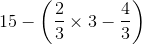
Evaluate:
Tap to see back →
By the order of operations, carry out the operations in parentheses first; since there is a multiplication and a subtraction present, carry them out in that order. Finally, carry out the remaining subtraction:
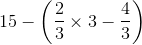
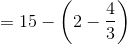


By the order of operations, carry out the operations in parentheses first; since there is a multiplication and a subtraction present, carry them out in that order. Finally, carry out the remaining subtraction:
Raise  to the fourth power.
Raise
Tap to see back →
To raise a negative number to an even-numbered power, raise its absolute value to that power:

To raise a negative number to an even-numbered power, raise its absolute value to that power:
Evaluate:

Evaluate:
Tap to see back →
By the order of operations, carry out the operation in parentheses, which is the rightmost subtraction, then the multiplication, then the leftmost subtraction:




By the order of operations, carry out the operation in parentheses, which is the rightmost subtraction, then the multiplication, then the leftmost subtraction: