Distributive Property - SSAT Middle Level Quantitative
Card 0 of 196
Which of the following expressions is equivalent to the expression  ?
?
Which of the following expressions is equivalent to the expression
Tap to see back →
By the distributive property of multiplication over addition,

By the distributive property of multiplication over addition,
Which of the following expressions is equivalent to the expression  ?
?
Which of the following expressions is equivalent to the expression
Tap to see back →
By the distributive property of multiplication over addition,

By the distributive property of multiplication over addition,
Which of the following expressions is equivalent to  ?
?
Which of the following expressions is equivalent to
Tap to see back →
When distributing, the number outside the parentheses is multiplied by both of the numbers inside without changing any signs.
When distributing, the number outside the parentheses is multiplied by both of the numbers inside without changing any signs.
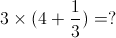
Tap to see back →
Using the distributive property we get: 
Using the distributive property we get:
Simplify the expression: 
Simplify the expression:
Tap to see back →
Apply the distributive property:



Apply the distributive property:
Simplify the expression: 
Simplify the expression:
Tap to see back →
Apply the distributive property:




Apply the distributive property:
Which of the following is an example of an application of the distributive property?
Which of the following is an example of an application of the distributive property?
Tap to see back →
According to the distributive property, for any values of  ,
,

If we set  , this become the statement
 ,
,
so this is the correct choice.
All of the other statements are true for different reasons:
 is true because of the associative property of multiplication.
 is true because of the commutative property of multiplication.
 is true because of the commutative property of addition.
 is true because of the identity property of multiplication.
According to the distributive property, for any values of
If we set
so this is the correct choice.
All of the other statements are true for different reasons:
Simplify the expression:

Simplify the expression:
Tap to see back →
Distribute, then collect like terms:





Distribute, then collect like terms:
Diana is thirty-three years older than her son Colin, who is three times as old as her niece Sharon. If  is Diana's age, how old is Sharon?
Diana is thirty-three years older than her son Colin, who is three times as old as her niece Sharon. If
Tap to see back →
Colin's age is thirty-three years less than Diana's age of  , so Colin is
  years old; Sharon is one-third of this, or
  . Using distribution, this can be rewritten as
 .
.
Colin's age is thirty-three years less than Diana's age of
Nina is twenty-one years younger than her mother Caroline, who is one-third as old as their neighbor Mr. Hutchinson. If  is Nina's age, how old is Mr. Hutchinson?
Nina is twenty-one years younger than her mother Caroline, who is one-third as old as their neighbor Mr. Hutchinson. If
Tap to see back →
Caroline is twenty-one years older than Nina, so her age is  . Mr. Hutchinson is three times as old as Caroline, so he is
  . Using distribution, this can be rewritten as
 .
.
Caroline is twenty-one years older than Nina, so her age is
Use the distributive property to express the sum  as the multiple of a sum of two whole numbers with no common factor.
Use the distributive property to express the sum
Tap to see back →
The distributive property can be used to rewrite an expression. When we use this property we will identify and pull out the greatest common factor of each of the addends. Then we can create a quantity that represents the sum of two whole numbers with no common factor multiplied by their greatest common factor.

In this case, the greatest common factor shared by each number is:

After we reduce each addend by the greatest common factor we can rewrite the expression:

The distributive property can be used to rewrite an expression. When we use this property we will identify and pull out the greatest common factor of each of the addends. Then we can create a quantity that represents the sum of two whole numbers with no common factor multiplied by their greatest common factor.
In this case, the greatest common factor shared by each number is:
After we reduce each addend by the greatest common factor we can rewrite the expression:
Use the distributive property to express the sum  as the multiple of a sum of two whole numbers with no common factor.
Use the distributive property to express the sum
Tap to see back →
The distributive property can be used to rewrite an expression. When we use this property we will identify and pull out the greatest common factor of each of the addends. Then we can create a quantity that represents the sum of two whole numbers with no common factor multiplied by their greatest common factor.

In this case, the greatest common factor shared by each number is:

After we reduce each addend by the greatest common factor we can rewrite the expression:

The distributive property can be used to rewrite an expression. When we use this property we will identify and pull out the greatest common factor of each of the addends. Then we can create a quantity that represents the sum of two whole numbers with no common factor multiplied by their greatest common factor.
In this case, the greatest common factor shared by each number is:
After we reduce each addend by the greatest common factor we can rewrite the expression:
Use the distributive property to express the sum  as the multiple of a sum of two whole numbers with no common factor.
Use the distributive property to express the sum
Tap to see back →
The distributive property can be used to rewrite an expression. When we use this property we will identify and pull out the greatest common factor of each of the addends. Then we can create a quantity that represents the sum of two whole numbers with no common factor multiplied by their greatest common factor.

In this case, the greatest common factor shared by each number is:

After we reduce each addend by the greatest common factor we can rewrite the expression:

The distributive property can be used to rewrite an expression. When we use this property we will identify and pull out the greatest common factor of each of the addends. Then we can create a quantity that represents the sum of two whole numbers with no common factor multiplied by their greatest common factor.
In this case, the greatest common factor shared by each number is:
After we reduce each addend by the greatest common factor we can rewrite the expression:
Use the distributive property to express the sum  as the multiple of a sum of two whole numbers with no common factor.
Use the distributive property to express the sum
Tap to see back →
The distributive property can be used to rewrite an expression. When we use this property we will identify and pull out the greatest common factor of each of the addends. Then we can create a quantity that represents the sum of two whole numbers with no common factor multiplied by their greatest common factor.

In this case, the greatest common factor shared by each number is:

After we reduce each addend by the greatest common factor we can rewrite the expression:

The distributive property can be used to rewrite an expression. When we use this property we will identify and pull out the greatest common factor of each of the addends. Then we can create a quantity that represents the sum of two whole numbers with no common factor multiplied by their greatest common factor.
In this case, the greatest common factor shared by each number is:
After we reduce each addend by the greatest common factor we can rewrite the expression:
Use the distributive property to express the sum  as the multiple of a sum of two whole numbers with no common factor.
Use the distributive property to express the sum
Tap to see back →
The distributive property can be used to rewrite an expression. When we use this property we will identify and pull out the greatest common factor of each of the addends. Then we can create a quantity that represents the sum of two whole numbers with no common factor multiplied by their greatest common factor.

In this case, the greatest common factor shared by each number is:

After we reduce each addend by the greatest common factor we can rewrite the expression:

The distributive property can be used to rewrite an expression. When we use this property we will identify and pull out the greatest common factor of each of the addends. Then we can create a quantity that represents the sum of two whole numbers with no common factor multiplied by their greatest common factor.
In this case, the greatest common factor shared by each number is:
After we reduce each addend by the greatest common factor we can rewrite the expression:
Use the distributive property to express the sum  as the multiple of a sum of two whole numbers with no common factor.
Use the distributive property to express the sum
Tap to see back →
The distributive property can be used to rewrite an expression. When we use this property we will identify and pull out the greatest common factor of each of the addends. Then we can create a quantity that represents the sum of two whole numbers with no common factor multiplied by their greatest common factor.

In this case, the greatest common factor shared by each number is:

After we reduce each addend by the greatest common factor we can rewrite the expression:

The distributive property can be used to rewrite an expression. When we use this property we will identify and pull out the greatest common factor of each of the addends. Then we can create a quantity that represents the sum of two whole numbers with no common factor multiplied by their greatest common factor.
In this case, the greatest common factor shared by each number is:
After we reduce each addend by the greatest common factor we can rewrite the expression:
Use the distributive property to express the sum  as the multiple of a sum of two whole numbers with no common factor.
Use the distributive property to express the sum
Tap to see back →
The distributive property can be used to rewrite an expression. When we use this property we will identify and pull out the greatest common factor of each of the addends. Then we can create a quantity that represents the sum of two whole numbers with no common factor multiplied by their greatest common factor.

In this case, the greatest common factor shared by each number is:

After we reduce each addend by the greatest common factor we can rewrite the expression:

The distributive property can be used to rewrite an expression. When we use this property we will identify and pull out the greatest common factor of each of the addends. Then we can create a quantity that represents the sum of two whole numbers with no common factor multiplied by their greatest common factor.
In this case, the greatest common factor shared by each number is:
After we reduce each addend by the greatest common factor we can rewrite the expression:
Use the distributive property to express the sum  as the multiple of a sum of two whole numbers with no common factor.
Use the distributive property to express the sum
Tap to see back →
The distributive property can be used to rewrite an expression. When we use this property we will identify and pull out the greatest common factor of each of the addends. Then we can create a quantity that represents the sum of two whole numbers with no common factor multiplied by their greatest common factor.

In this case, the greatest common factor shared by each number is:

After we reduce each addend by the greatest common factor we can rewrite the expression:

The distributive property can be used to rewrite an expression. When we use this property we will identify and pull out the greatest common factor of each of the addends. Then we can create a quantity that represents the sum of two whole numbers with no common factor multiplied by their greatest common factor.
In this case, the greatest common factor shared by each number is:
After we reduce each addend by the greatest common factor we can rewrite the expression:
Use the distributive property to express the sum  as the multiple of a sum of two whole numbers with no common factor.
Use the distributive property to express the sum
Tap to see back →
The distributive property can be used to rewrite an expression. When we use this property we will identify and pull out the greatest common factor of each of the addends. Then we can create a quantity that represents the sum of two whole numbers with no common factor multiplied by their greatest common factor.

In this case, the greatest common factor shared by each number is:

After we reduce each addend by the greatest common factor we can rewrite the expression:

The distributive property can be used to rewrite an expression. When we use this property we will identify and pull out the greatest common factor of each of the addends. Then we can create a quantity that represents the sum of two whole numbers with no common factor multiplied by their greatest common factor.
In this case, the greatest common factor shared by each number is:
After we reduce each addend by the greatest common factor we can rewrite the expression:
Use the distributive property to express the sum  as the multiple of a sum of two whole numbers with no common factor.
Use the distributive property to express the sum
Tap to see back →
The distributive property can be used to rewrite an expression. When we use this property we will identify and pull out the greatest common factor of each of the addends. Then we can create a quantity that represents the sum of two whole numbers with no common factor multiplied by their greatest common factor.

In this case, the greatest common factor shared by each number is:

After we reduce each addend by the greatest common factor we can rewrite the expression:

The distributive property can be used to rewrite an expression. When we use this property we will identify and pull out the greatest common factor of each of the addends. Then we can create a quantity that represents the sum of two whole numbers with no common factor multiplied by their greatest common factor.
In this case, the greatest common factor shared by each number is:
After we reduce each addend by the greatest common factor we can rewrite the expression: