Squares / Square Roots - SSAT Middle Level Quantitative
Card 0 of 108

Tap to see back →
If  , then
  .
.

Therefore,  .
.
If
Therefore,
Which of the following numbers has a square root between 18 and 19?
Which of the following numbers has a square root between 18 and 19?
Tap to see back →
For the square root of a number to fall between 18 and 19, the number has to fall between the squares of these numbers - that is:
If  , then
  , or, equivalently,
All four choices fall in this range.
For the square root of a number to fall between 18 and 19, the number has to fall between the squares of these numbers - that is:
If
All four choices fall in this range.
Evaluate: 
Evaluate:
Tap to see back →
Find the individual square roots and perform the operations on them.



Find the individual square roots and perform the operations on them.
The square root of a number is 43. What is that number?
The square root of a number is 43. What is that number?
Tap to see back →
By definition, the square root of a number multiplied by itself yields that number. Therefore, 43 is the square root of  .
.
By definition, the square root of a number multiplied by itself yields that number. Therefore, 43 is the square root of
The square root of a number is 58. What is that number?
The square root of a number is 58. What is that number?
Tap to see back →
By definition, the square root of a number multiplied by itself yields that number. Therefore,
 .
.
By definition, the square root of a number multiplied by itself yields that number. Therefore,
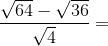
Tap to see back →
First, find the square root of each number:


Then, solve the equation accordingly.


The answer is 
First, find the square root of each number:
Then, solve the equation accordingly.
The answer is
Evaluate: 
Evaluate:
Tap to see back →
The square root of a number is the number which, when multiplied by itself, yields that number. Since  ,
,  .
.
The square root of a number is the number which, when multiplied by itself, yields that number. Since
Evaluate:

Evaluate:
Tap to see back →
The square root of a number is the number which, when multiplied by itself, yields that number. Since  ,
,  .
.
The square root of a number is the number which, when multiplied by itself, yields that number. Since
Which of the following statements is true about  ?
?
Which of the following statements is true about
Tap to see back →
The square root of a number is the number which, when multiplied by itself, yields that number. Since  ,
,  .
.
The square root of a number is the number which, when multiplied by itself, yields that number. Since
Which of the following statements is true about  ?
?
Which of the following statements is true about
Tap to see back →
The square root of a number is the number which, when multiplied by itself, yields that number. Since  ,
,  , and
, and

then

The square root of a number is the number which, when multiplied by itself, yields that number. Since
then
A square has an area of  .
.
How long is each of its sides?
A square has an area of
How long is each of its sides?
Tap to see back →
The two sides of the square must be the same length, and multiply to give 16. So we are looking for the  which is
  .
.
The two sides of the square must be the same length, and multiply to give 16. So we are looking for the
Which of the following statements is true about  ?
?
Which of the following statements is true about
Tap to see back →
A negative number does not have a real square root, so this is the correct choice.
A negative number does not have a real square root, so this is the correct choice.
Evaluate:

Evaluate:
Tap to see back →
 , so
, so  .
.
 , so
, so  .
.

Let 
Which of the following is a true statement?
Let
Which of the following is a true statement?
Tap to see back →

Since  ,
, 
Since
Let 
Then which of the following statements is correct?
Let
Then which of the following statements is correct?
Tap to see back →

 , so
, so


Which of the answer choices is equivalent to  ?
?
Which of the answer choices is equivalent to
Tap to see back →
 can also be written as
  , so
, so  can also be written as
  , or
, or  .
.
Which of the answer choices is equivalent to  ?
?
Which of the answer choices is equivalent to
Tap to see back →
Recognize that  . Since
  , we can move the
  outside of the radical sign. This leaves us with
  .
.
Recognize that
What is the square root of  ?
?
What is the square root of
Tap to see back →
The square root of  is
is  , since
  .
.
The square root of
Evaluate:

Evaluate:
Tap to see back →
To find the square root of a fraction, extract the square root of both the numerator and the denominator. Since  ,
,  , and since
  ,
,  .
.
Combine these results:

To find the square root of a fraction, extract the square root of both the numerator and the denominator. Since
Combine these results:
Evaluate:

Evaluate:
Tap to see back →
 , so
, so
 .
.
The square root of a fraction can be determined by taking the square roots of both numerator and denominator. Since  ,
,  , and since
  ,
,  . Therefore,
 .
.
The square root of a fraction can be determined by taking the square roots of both numerator and denominator. Since