Apply Basic and Definitional Identities - Trigonometry
Card 1 of 32
Which of the following identities is incorrect?
Which of the following identities is incorrect?
Tap to reveal answer
The true identity is  because cosine is an even function.
The true identity is
← Didn't Know|Knew It →
Which of the following trigonometric identities is INCORRECT?
Which of the following trigonometric identities is INCORRECT?
Tap to reveal answer
Cosine and sine are not reciprocal functions.
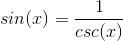 and
and 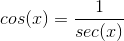
Cosine and sine are not reciprocal functions.
← Didn't Know|Knew It →
Using the trigonometric identities prove whether the following is valid:
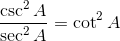
Using the trigonometric identities prove whether the following is valid:
Tap to reveal answer
We begin with the left hand side of the equation and utilize basic trigonometric identities, beginning with converting the inverse functions to their corresponding base functions:
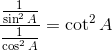
Next we rewrite the fractional division in order to simplify the equation:

In fractional division we multiply by the reciprocal as follows:
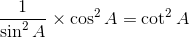
If we reduce the fraction using basic identities we see that the equivalence is proven:
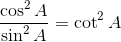

We begin with the left hand side of the equation and utilize basic trigonometric identities, beginning with converting the inverse functions to their corresponding base functions:
Next we rewrite the fractional division in order to simplify the equation:
In fractional division we multiply by the reciprocal as follows:
If we reduce the fraction using basic identities we see that the equivalence is proven:
← Didn't Know|Knew It →
Which of the following is the best answer for  ?
?
Which of the following is the best answer for
Tap to reveal answer
Write the Pythagorean identity.

Substract  from both sides.

The other answers are incorrect.
Write the Pythagorean identity.
Substract
The other answers are incorrect.
← Didn't Know|Knew It →
State  in terms of sine and cosine.
State
Tap to reveal answer
The definition of tangent is sine divided by cosine.
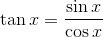
The definition of tangent is sine divided by cosine.
← Didn't Know|Knew It →
Simplify.

Simplify.
Tap to reveal answer
Using these basic identities:



we find the original expression to be

which simplifies to
 .
.
Further simplifying:
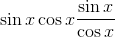
The cosines cancel, giving us

Using these basic identities:
we find the original expression to be
which simplifies to
Further simplifying:
The cosines cancel, giving us
← Didn't Know|Knew It →
Express 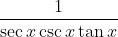 in terms of only sines and cosines.
Express 
Tap to reveal answer
The correct answer is  . Begin by substituting
  ,
,  , and
, and 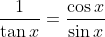 . This gives us:
 .
.
The correct answer is 


← Didn't Know|Knew It →
Express 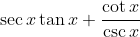 in terms of only sines and cosines.
Express 
Tap to reveal answer
To solve this problem, use the identities 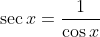 ,
, 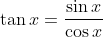 ,
, 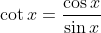 , and
, and  . Then we get
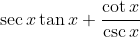

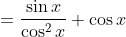
To solve this problem, use the identities 

← Didn't Know|Knew It →
Which of the following identities is incorrect?
Which of the following identities is incorrect?
Tap to reveal answer
The true identity is because cosine is an even function.
The true identity is
← Didn't Know|Knew It →
Which of the following trigonometric identities is INCORRECT?
Which of the following trigonometric identities is INCORRECT?
Tap to reveal answer
Cosine and sine are not reciprocal functions.
and
Cosine and sine are not reciprocal functions.
← Didn't Know|Knew It →
Using the trigonometric identities prove whether the following is valid:
Using the trigonometric identities prove whether the following is valid:
Tap to reveal answer
We begin with the left hand side of the equation and utilize basic trigonometric identities, beginning with converting the inverse functions to their corresponding base functions:
Next we rewrite the fractional division in order to simplify the equation:
In fractional division we multiply by the reciprocal as follows:
If we reduce the fraction using basic identities we see that the equivalence is proven:
We begin with the left hand side of the equation and utilize basic trigonometric identities, beginning with converting the inverse functions to their corresponding base functions:
Next we rewrite the fractional division in order to simplify the equation:
In fractional division we multiply by the reciprocal as follows:
If we reduce the fraction using basic identities we see that the equivalence is proven:
← Didn't Know|Knew It →
Which of the following is the best answer for ?
Which of the following is the best answer for
Tap to reveal answer
Write the Pythagorean identity.
Substract from both sides.
The other answers are incorrect.
Write the Pythagorean identity.
Substract
The other answers are incorrect.
← Didn't Know|Knew It →
State in terms of sine and cosine.
State
Tap to reveal answer
The definition of tangent is sine divided by cosine.
The definition of tangent is sine divided by cosine.
← Didn't Know|Knew It →
Simplify.
Simplify.
Tap to reveal answer
Using these basic identities:
we find the original expression to be
which simplifies to
.
Further simplifying:
The cosines cancel, giving us
Using these basic identities:
we find the original expression to be
which simplifies to
Further simplifying:
The cosines cancel, giving us
← Didn't Know|Knew It →
Express in terms of only sines and cosines.
Express
Tap to reveal answer
The correct answer is . Begin by substituting , , and . This gives us:
.
The correct answer is
← Didn't Know|Knew It →
Express in terms of only sines and cosines.
Express
Tap to reveal answer
To solve this problem, use the identities , , , and . Then we get
To solve this problem, use the identities
← Didn't Know|Knew It →
Which of the following identities is incorrect?
Which of the following identities is incorrect?
Tap to reveal answer
The true identity is because cosine is an even function.
The true identity is
← Didn't Know|Knew It →
Which of the following trigonometric identities is INCORRECT?
Which of the following trigonometric identities is INCORRECT?
Tap to reveal answer
Cosine and sine are not reciprocal functions.
and
Cosine and sine are not reciprocal functions.
← Didn't Know|Knew It →
Using the trigonometric identities prove whether the following is valid:
Using the trigonometric identities prove whether the following is valid:
Tap to reveal answer
We begin with the left hand side of the equation and utilize basic trigonometric identities, beginning with converting the inverse functions to their corresponding base functions:
Next we rewrite the fractional division in order to simplify the equation:
In fractional division we multiply by the reciprocal as follows:
If we reduce the fraction using basic identities we see that the equivalence is proven:
We begin with the left hand side of the equation and utilize basic trigonometric identities, beginning with converting the inverse functions to their corresponding base functions:
Next we rewrite the fractional division in order to simplify the equation:
In fractional division we multiply by the reciprocal as follows:
If we reduce the fraction using basic identities we see that the equivalence is proven:
← Didn't Know|Knew It →
Which of the following is the best answer for ?
Which of the following is the best answer for
Tap to reveal answer
Write the Pythagorean identity.
Substract from both sides.
The other answers are incorrect.
Write the Pythagorean identity.
Substract
The other answers are incorrect.
← Didn't Know|Knew It →