Complementary and Supplementary Identities - Trigonometry
Card 1 of 24

Which of the following is equivalent to the function above.
Which of the following is equivalent to the function above.
Tap to reveal answer
The cosine graph at zero has a peak at 1.
The first peak in the sine curve is at π/2, so you adjust the cosine with a -π/2 and that gives the answer 
The cosine graph at zero has a peak at 1.
The first peak in the sine curve is at π/2, so you adjust the cosine with a -π/2 and that gives the answer
← Didn't Know|Knew It →
Which of those below is equivalent to  ?
?
Which of those below is equivalent to
Tap to reveal answer
Think of a right triangle. The two non-right angles are complementary since the angles in a triangle add up to 180. As a result, when we apply the definitions of sine and cosine, we get that the sine of one of these angles is equivalent to the cosine of the other. As a result, the sine of one angle is equal to the cosine of its complement and vice versa.
Therefore, when we look at the angles of a right triangle that includes a 60 degree angle we get
 .
.
Thus the 
Think of a right triangle. The two non-right angles are complementary since the angles in a triangle add up to 180. As a result, when we apply the definitions of sine and cosine, we get that the sine of one of these angles is equivalent to the cosine of the other. As a result, the sine of one angle is equal to the cosine of its complement and vice versa.
Therefore, when we look at the angles of a right triangle that includes a 60 degree angle we get
Thus the
← Didn't Know|Knew It →
Given that  , which of the following must also be true?
Given that
Tap to reveal answer
The supplementary angle identity states that in the positive quadrants, if two angles are supplementary (add to 180 degrees), they must have the same sine. In other words,
if  , then
Using this, we can see that

Thus, if  , then
  also.
also.
The supplementary angle identity states that in the positive quadrants, if two angles are supplementary (add to 180 degrees), they must have the same sine. In other words,
if
Using this, we can see that
Thus, if
← Didn't Know|Knew It →
Which of the following is equivalent to  ?
?
Which of the following is equivalent to
Tap to reveal answer
Recall that the cosine and sine of complementary angles are equal.
Thus, we are looking for the complement of 70, which gives us 20.
When we take the cosine of this, we will get an equivalent statement.
Recall that the cosine and sine of complementary angles are equal.
Thus, we are looking for the complement of 70, which gives us 20.
When we take the cosine of this, we will get an equivalent statement.
← Didn't Know|Knew It →
Simplify the following expression:

Simplify the following expression:
Tap to reveal answer
Simplifying this expression relies on an understanding of the cofunction identities. The cofunction identities hinge on the fact that the value of a trig function of a particular angle is equal to the value of the cofunction of the the complement of that angle. In other words,






That means that returning to our initial expression, we can do some substiution.
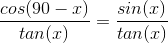
We then turn to another identity, namely the fact that tangent is just the quotient of sine and cosine.
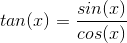
We can substitute again
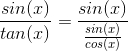
Yet dividing by a fraction is the same as multipying by the reciprocal.

With some cancellation, we have arrived at our answer.
Simplifying this expression relies on an understanding of the cofunction identities. The cofunction identities hinge on the fact that the value of a trig function of a particular angle is equal to the value of the cofunction of the the complement of that angle. In other words,
That means that returning to our initial expression, we can do some substiution.
We then turn to another identity, namely the fact that tangent is just the quotient of sine and cosine.
We can substitute again
Yet dividing by a fraction is the same as multipying by the reciprocal.
With some cancellation, we have arrived at our answer.
← Didn't Know|Knew It →
Which one is equal to 
Which one is equal to
Tap to reveal answer
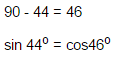
Complementary angles are equal to one's  to others
Complementary angles are equal to one's
← Didn't Know|Knew It →
Which of those below is equivalent to ?
Which of those below is equivalent to
Tap to reveal answer
Think of a right triangle. The two non-right angles are complementary since the angles in a triangle add up to 180. As a result, when we apply the definitions of sine and cosine, we get that the sine of one of these angles is equivalent to the cosine of the other. As a result, the sine of one angle is equal to the cosine of its complement and vice versa.
Therefore, when we look at the angles of a right triangle that includes a 60 degree angle we get
.
Thus the
Think of a right triangle. The two non-right angles are complementary since the angles in a triangle add up to 180. As a result, when we apply the definitions of sine and cosine, we get that the sine of one of these angles is equivalent to the cosine of the other. As a result, the sine of one angle is equal to the cosine of its complement and vice versa.
Therefore, when we look at the angles of a right triangle that includes a 60 degree angle we get
Thus the
← Didn't Know|Knew It →
Given that , which of the following must also be true?
Given that
Tap to reveal answer
The supplementary angle identity states that in the positive quadrants, if two angles are supplementary (add to 180 degrees), they must have the same sine. In other words,
if , then
Using this, we can see that
Thus, if , then also.
The supplementary angle identity states that in the positive quadrants, if two angles are supplementary (add to 180 degrees), they must have the same sine. In other words,
if
Using this, we can see that
Thus, if
← Didn't Know|Knew It →
Which of the following is equivalent to ?
Which of the following is equivalent to
Tap to reveal answer
Recall that the cosine and sine of complementary angles are equal.
Thus, we are looking for the complement of 70, which gives us 20.
When we take the cosine of this, we will get an equivalent statement.
Recall that the cosine and sine of complementary angles are equal.
Thus, we are looking for the complement of 70, which gives us 20.
When we take the cosine of this, we will get an equivalent statement.
← Didn't Know|Knew It →
Which of the following is equivalent to the function above.
Which of the following is equivalent to the function above.
Tap to reveal answer
The cosine graph at zero has a peak at 1.
The first peak in the sine curve is at π/2, so you adjust the cosine with a -π/2 and that gives the answer
The cosine graph at zero has a peak at 1.
The first peak in the sine curve is at π/2, so you adjust the cosine with a -π/2 and that gives the answer
← Didn't Know|Knew It →
Simplify the following expression:
Simplify the following expression:
Tap to reveal answer
Simplifying this expression relies on an understanding of the cofunction identities. The cofunction identities hinge on the fact that the value of a trig function of a particular angle is equal to the value of the cofunction of the the complement of that angle. In other words,
That means that returning to our initial expression, we can do some substiution.
We then turn to another identity, namely the fact that tangent is just the quotient of sine and cosine.
We can substitute again
Yet dividing by a fraction is the same as multipying by the reciprocal.
With some cancellation, we have arrived at our answer.
Simplifying this expression relies on an understanding of the cofunction identities. The cofunction identities hinge on the fact that the value of a trig function of a particular angle is equal to the value of the cofunction of the the complement of that angle. In other words,
That means that returning to our initial expression, we can do some substiution.
We then turn to another identity, namely the fact that tangent is just the quotient of sine and cosine.
We can substitute again
Yet dividing by a fraction is the same as multipying by the reciprocal.
With some cancellation, we have arrived at our answer.
← Didn't Know|Knew It →
Which one is equal to
Which one is equal to
Tap to reveal answer
Complementary angles are equal to one's to others
Complementary angles are equal to one's
← Didn't Know|Knew It →
Which of those below is equivalent to ?
Which of those below is equivalent to
Tap to reveal answer
Think of a right triangle. The two non-right angles are complementary since the angles in a triangle add up to 180. As a result, when we apply the definitions of sine and cosine, we get that the sine of one of these angles is equivalent to the cosine of the other. As a result, the sine of one angle is equal to the cosine of its complement and vice versa.
Therefore, when we look at the angles of a right triangle that includes a 60 degree angle we get
.
Thus the
Think of a right triangle. The two non-right angles are complementary since the angles in a triangle add up to 180. As a result, when we apply the definitions of sine and cosine, we get that the sine of one of these angles is equivalent to the cosine of the other. As a result, the sine of one angle is equal to the cosine of its complement and vice versa.
Therefore, when we look at the angles of a right triangle that includes a 60 degree angle we get
Thus the
← Didn't Know|Knew It →
Given that , which of the following must also be true?
Given that
Tap to reveal answer
The supplementary angle identity states that in the positive quadrants, if two angles are supplementary (add to 180 degrees), they must have the same sine. In other words,
if , then
Using this, we can see that
Thus, if , then also.
The supplementary angle identity states that in the positive quadrants, if two angles are supplementary (add to 180 degrees), they must have the same sine. In other words,
if
Using this, we can see that
Thus, if
← Didn't Know|Knew It →
Which of the following is equivalent to ?
Which of the following is equivalent to
Tap to reveal answer
Recall that the cosine and sine of complementary angles are equal.
Thus, we are looking for the complement of 70, which gives us 20.
When we take the cosine of this, we will get an equivalent statement.
Recall that the cosine and sine of complementary angles are equal.
Thus, we are looking for the complement of 70, which gives us 20.
When we take the cosine of this, we will get an equivalent statement.
← Didn't Know|Knew It →
Which of the following is equivalent to the function above.
Which of the following is equivalent to the function above.
Tap to reveal answer
The cosine graph at zero has a peak at 1.
The first peak in the sine curve is at π/2, so you adjust the cosine with a -π/2 and that gives the answer
The cosine graph at zero has a peak at 1.
The first peak in the sine curve is at π/2, so you adjust the cosine with a -π/2 and that gives the answer
← Didn't Know|Knew It →
Simplify the following expression:
Simplify the following expression:
Tap to reveal answer
Simplifying this expression relies on an understanding of the cofunction identities. The cofunction identities hinge on the fact that the value of a trig function of a particular angle is equal to the value of the cofunction of the the complement of that angle. In other words,
That means that returning to our initial expression, we can do some substiution.
We then turn to another identity, namely the fact that tangent is just the quotient of sine and cosine.
We can substitute again
Yet dividing by a fraction is the same as multipying by the reciprocal.
With some cancellation, we have arrived at our answer.
Simplifying this expression relies on an understanding of the cofunction identities. The cofunction identities hinge on the fact that the value of a trig function of a particular angle is equal to the value of the cofunction of the the complement of that angle. In other words,
That means that returning to our initial expression, we can do some substiution.
We then turn to another identity, namely the fact that tangent is just the quotient of sine and cosine.
We can substitute again
Yet dividing by a fraction is the same as multipying by the reciprocal.
With some cancellation, we have arrived at our answer.
← Didn't Know|Knew It →
Which one is equal to
Which one is equal to
Tap to reveal answer
Complementary angles are equal to one's to others
Complementary angles are equal to one's
← Didn't Know|Knew It →
Which of the following is equivalent to the function above.
Which of the following is equivalent to the function above.
Tap to reveal answer
The cosine graph at zero has a peak at 1.
The first peak in the sine curve is at π/2, so you adjust the cosine with a -π/2 and that gives the answer
The cosine graph at zero has a peak at 1.
The first peak in the sine curve is at π/2, so you adjust the cosine with a -π/2 and that gives the answer
← Didn't Know|Knew It →
Which of those below is equivalent to ?
Which of those below is equivalent to
Tap to reveal answer
Think of a right triangle. The two non-right angles are complementary since the angles in a triangle add up to 180. As a result, when we apply the definitions of sine and cosine, we get that the sine of one of these angles is equivalent to the cosine of the other. As a result, the sine of one angle is equal to the cosine of its complement and vice versa.
Therefore, when we look at the angles of a right triangle that includes a 60 degree angle we get
.
Thus the
Think of a right triangle. The two non-right angles are complementary since the angles in a triangle add up to 180. As a result, when we apply the definitions of sine and cosine, we get that the sine of one of these angles is equivalent to the cosine of the other. As a result, the sine of one angle is equal to the cosine of its complement and vice versa.
Therefore, when we look at the angles of a right triangle that includes a 60 degree angle we get
Thus the
← Didn't Know|Knew It →