Law of Sines - Trigonometry
Card 1 of 104

In the above triangle,  and
and  . If
. If  , what is
  to the nearest tenth? (note: triangle not to scale)
In the above triangle,
Tap to reveal answer
If we solve for  , we can use the Law of Sines to find
  .
.
Since the sum of angles in a triangle equals  ,
,


Now, using the Law of Sines:


If we solve for
Since the sum of angles in a triangle equals
Now, using the Law of Sines:
← Didn't Know|Knew It →

Given sides  ,
,  and angle
  determine the corresponding value for
Given sides
Tap to reveal answer
The Law of Sines is used here since we have Side - Angle - Side. We setup our equation as follows:

Next, we substitute the known values:

Now we cross multiply:

Divide by 10 on both sides:

Finally taking the inverse sine to obtain the desired angle:

The Law of Sines is used here since we have Side - Angle - Side. We setup our equation as follows:
Next, we substitute the known values:
Now we cross multiply:
Divide by 10 on both sides:
Finally taking the inverse sine to obtain the desired angle:
← Didn't Know|Knew It →
Let  ,
,  and
and  , determine the length of side
  .
.

Let
Tap to reveal answer
We have two angles and one side, however we do not have  . We can determine the angle using the property of angles in a triangle summing to
  :
:

Now we can simply utilize the Law of Sines:

Cross multiply and divide:

Reducing to obtain the final solution:

We have two angles and one side, however we do not have
Now we can simply utilize the Law of Sines:
Cross multiply and divide:
Reducing to obtain the final solution:
← Didn't Know|Knew It →
If  ,
,  , and
, and  determine the length of side
  , round to the nearest whole number.

If
Tap to reveal answer
This is a straightforward Law of Sines problem as we are given two angles and a corresponding side:

Substituting the known values:

Solving for the unknown side:

This is a straightforward Law of Sines problem as we are given two angles and a corresponding side:
Substituting the known values:
Solving for the unknown side:
← Didn't Know|Knew It →
If  ,
,  , and
, and  determine the measure of
  , round to the nearest degree.
If
Tap to reveal answer
This is a straightforward Law of Sines problem since we are given one angle and two sides and are asked to determine the corresponding angle.

Substituting the given values:

Now rearranging the equation:

The final step is to take the inverse sine of both sides:

This is a straightforward Law of Sines problem since we are given one angle and two sides and are asked to determine the corresponding angle.
Substituting the given values:
Now rearranging the equation:
The final step is to take the inverse sine of both sides:
← Didn't Know|Knew It →

By what factor is  larger than
  in the triangle pictured above.
By what factor is
Tap to reveal answer
The Law of Sines states

so for a and b, that sets up

The Law of Sines states
so for a and b, that sets up
← Didn't Know|Knew It →
If  ,
,  =
=  , and
, and  =
=  , find the length of side
  .
.
If
Tap to reveal answer
We are given two angles and the length of the corresponding side to one of those angles. Because the problem is asking for the corresponding length of the other angle we can use the Law of Sines to find the length of the side  . The equation for the Law of Sines is

If we rearrange the equation to isolate  we obtain

Substituting on the values given in the problem


We are given two angles and the length of the corresponding side to one of those angles. Because the problem is asking for the corresponding length of the other angle we can use the Law of Sines to find the length of the side
If we rearrange the equation to isolate
Substituting on the values given in the problem
← Didn't Know|Knew It →
If  ,
,  =
=  , and
, and  =
=  , find the length of side
  to the nearest whole number.
If
Tap to reveal answer
Because we are given the two angles and the length of the corresponding side to one of those angles, we can use the Law of Sines to find the length of the side that we need. So we use the equation

Rearranging the equation to isolate  gives
gives

Substituting in the values from the problem gives


Because we are given the two angles and the length of the corresponding side to one of those angles, we can use the Law of Sines to find the length of the side that we need. So we use the equation
Rearranging the equation to isolate
Substituting in the values from the problem gives
← Didn't Know|Knew It →
If  ,
,  , and
, and  , find
  to the nearest whole number.
If
Tap to reveal answer
We can use the Law of Sines to find the length of the missing side, because we have its corresponding angle and the length and angle of another side. The equation for the Law of Sines is

Isolating  gives us

Finally, substituting in the values of the of from the problem gives


We can use the Law of Sines to find the length of the missing side, because we have its corresponding angle and the length and angle of another side. The equation for the Law of Sines is
Isolating
Finally, substituting in the values of the of from the problem gives
← Didn't Know|Knew It →
Solve for  :
:

Solve for
Tap to reveal answer
To solve, use the law of sines,  where a is the side across from the angle A, and b is the side across from the angle B.
 cross-multiply
 evaluate the right side
 divide by 7
 take the inverse sine

To solve, use the law of sines,
← Didn't Know|Knew It →
Evaluate using law of sines:

Evaluate using law of sines:
Tap to reveal answer
To solve, use law of sines,  where side a is across from angle A, and side b is across from angle B.
In this case, we have a 90-degree angle across from x, but we don't currently know the angle across from the side length 7. We can figure out this angle by subtracting  from
from  :
:

Now we can set up and solve using law of sines:
 cross-multiply
 evaluate the sines
 divide by 0.9063

To solve, use law of sines,
In this case, we have a 90-degree angle across from x, but we don't currently know the angle across from the side length 7. We can figure out this angle by subtracting
Now we can set up and solve using law of sines:
← Didn't Know|Knew It →
If  , find the remaining angles and sides.
If
Tap to reveal answer
The Law of Sines is a set of ratios that allows one to compute missing angles and side lengths of oblique triangles (non right angle triangles).
The Law of Sines:
 .
.
To find the missing angle A we subtract the sum of the two known angles from 180° as the interior angles of all triangles equal 180°.

The LOS can be rearranged to solve for the missing side.


The Law of Sines is a set of ratios that allows one to compute missing angles and side lengths of oblique triangles (non right angle triangles).
The Law of Sines:
To find the missing angle A we subtract the sum of the two known angles from 180° as the interior angles of all triangles equal 180°.
The LOS can be rearranged to solve for the missing side.
← Didn't Know|Knew It →
Find the length of the line segment  in the triangle below.
Round to the nearest hundredth of a centimeter.

Find the length of the line segment
Round to the nearest hundredth of a centimeter.
Tap to reveal answer
The law of sines states that
 .
.
In this triangle, we are looking for the side length c, and we are given angle A, angle B, and side b. The sum of the interior angles of a triangle is  ; using subtraction we find that angle C =
  .
.
We can now form a proportion that includes only one unknown, c:

Solving for c, we find that
 .
.
The law of sines states that
In this triangle, we are looking for the side length c, and we are given angle A, angle B, and side b. The sum of the interior angles of a triangle is
We can now form a proportion that includes only one unknown, c:
Solving for c, we find that
← Didn't Know|Knew It →
What is the measure of  in
in  below? Round to the nearest tenth of a degree.

What is the measure of
Tap to reveal answer
The law of sines tells us that  , where a, b, and c are the sides opposite of angles A, B, and C. In
  , these ratios can be used to find
  :
:


The law of sines tells us that
← Didn't Know|Knew It →
In the triangle below,  ,
,  , and
, and  . What is the length of side
  to the nearest tenth?

In the triangle below,
Tap to reveal answer
First, find  . The sum of the interior angles of a triangle is
  , so
, so  , or
, or  .
.
Using this information, you can set up a proportion to find side b:


First, find
Using this information, you can set up a proportion to find side b:
← Didn't Know|Knew It →
In the triangle below,  ,
,  , and
, and  .
.
What is the length of side a to the nearest tenth?
In the triangle below,
What is the length of side a to the nearest tenth?
Tap to reveal answer
To use the law of sines, first you must find the measure of  . Since the sum of the interior angles of a triangle is
  ,
,  .
.
Law of sines:


To use the law of sines, first you must find the measure of
Law of sines:
← Didn't Know|Knew It →

The triangle above has side lengths 3, 4, and 6. The angle opposite the side of length 6 measures 117.28 degrees, rounded to the nearest hundredth. Angle  is opposite the side of length 3. What is the measure of
  , rounded to the nearest hundredth of a degree?
The triangle above has side lengths 3, 4, and 6. The angle opposite the side of length 6 measures 117.28 degrees, rounded to the nearest hundredth. Angle
Tap to reveal answer
Because the angle with measure 117.28 degrees is opposite the side of length 6, and angle  is opposite the side of length 3, we can use the Law of Sines to solve for the measure of
  .
.


Because the angle with measure 117.28 degrees is opposite the side of length 6, and angle
← Didn't Know|Knew It →
Find the length of side a using the law of sines. All angles are in degrees.

Find the length of side a using the law of sines. All angles are in degrees.
Tap to reveal answer
The law of sines states that, given a triangle with sides a, b, and c and angles A, B, and C opposite to the corresponding sides,

Since the sides and angles given are directly opposite, we can use the law of sines.

Solving for a, we get

Evaluating the expression, we find that 
The law of sines states that, given a triangle with sides a, b, and c and angles A, B, and C opposite to the corresponding sides,
Since the sides and angles given are directly opposite, we can use the law of sines.
Solving for a, we get
Evaluating the expression, we find that
← Didn't Know|Knew It →
Find the measure of angle A.

Find the measure of angle A.
Tap to reveal answer
The law of sines states that, given a triangle, the following relationship is always true:

where a, b, and c are sides and A, B, and C are the angles opposite to the sides.
This problem does not give us the length of the side opposite to the angle we want to find, so we have to find it indirectly.
We start by finding the measure of the unmarked angle, which we'll represent as B:

Solving for  , we get


Now that we have the measures of two angles, we can find the measure of the third by the  theorem:


The law of sines states that, given a triangle, the following relationship is always true:
where a, b, and c are sides and A, B, and C are the angles opposite to the sides.
This problem does not give us the length of the side opposite to the angle we want to find, so we have to find it indirectly.
We start by finding the measure of the unmarked angle, which we'll represent as B:
Solving for
Now that we have the measures of two angles, we can find the measure of the third by the
← Didn't Know|Knew It →
Find the length of side  .
.

Find the length of side
Tap to reveal answer
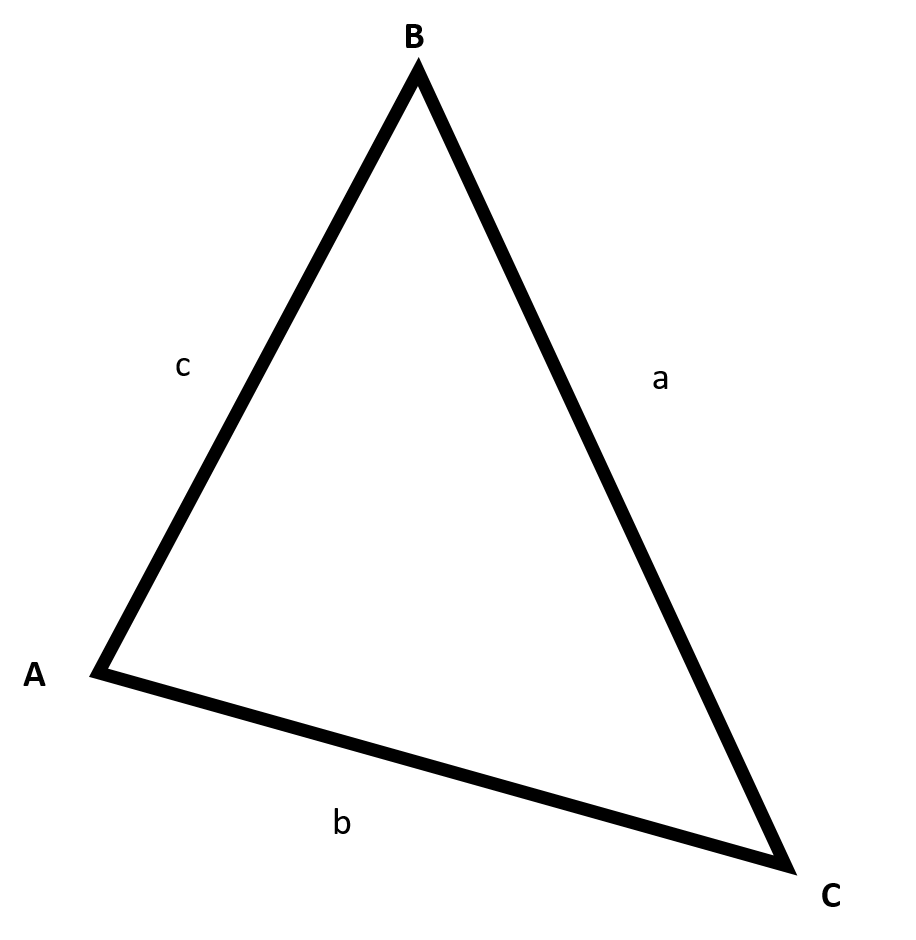
Recall the Law of Sines:

Start by finding the value of angle  :
:


Plug in the given values into the Law of Sines:

Rearrange the equation to solve for  :
:

Make sure to round to two places after the decimal.
Recall the Law of Sines:
Start by finding the value of angle
Plug in the given values into the Law of Sines:
Rearrange the equation to solve for
Make sure to round to two places after the decimal.
← Didn't Know|Knew It →