Phase Shifts - Trigonometry
Card 1 of 32
Which of the following is equivalent to 
Which of the following is equivalent to
Tap to reveal answer
The first zero can be found by plugging 3π/2 for x, and noting that it is a double period function, the zeros are every π/2, count three back and there is a zero at zero, going down.
A more succinct form for this answer is  but that was not one of the options, so a shifted cosine must be the answer.
The first positive peak is at π/4 at -1, so the cosine function will be shifted π/4 to the right and multiplied by -1. The period and amplitude still 2, so the answer becomes 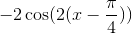 .
.
To check, plug in π/4 for x and it will come out to -2.
The first zero can be found by plugging 3π/2 for x, and noting that it is a double period function, the zeros are every π/2, count three back and there is a zero at zero, going down.
A more succinct form for this answer is
The first positive peak is at π/4 at -1, so the cosine function will be shifted π/4 to the right and multiplied by -1. The period and amplitude still 2, so the answer becomes
To check, plug in π/4 for x and it will come out to -2.
← Didn't Know|Knew It →
Identify the phase shift of the following equation.

Identify the phase shift of the following equation.
Tap to reveal answer
If we use the standard form of a sine function

the phase shift can be calculated by  . Therefore, in our case, our phase shift is

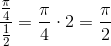
If we use the standard form of a sine function
the phase shift can be calculated by
← Didn't Know|Knew It →
Which of the following is the correct definition of a phase shift?
Which of the following is the correct definition of a phase shift?
Tap to reveal answer
Take the function  for example. The graph for
  is
is
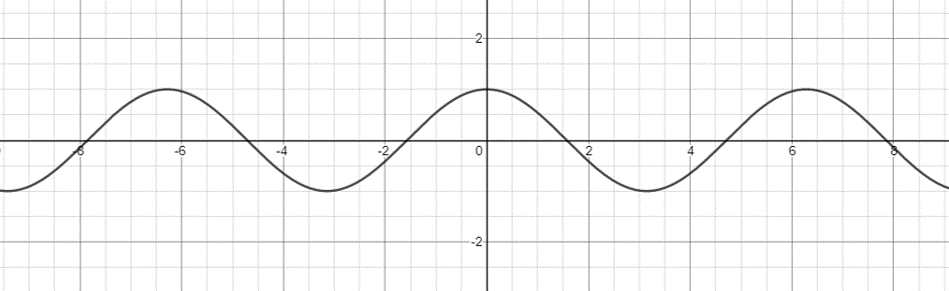
If we were to change the function to  , our phase shift is
  . This means we need to shift our entire graph
  units to the left.
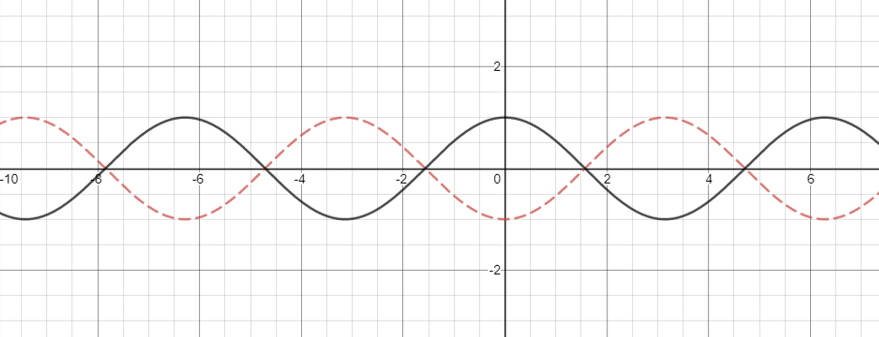
Our new graph  is the following
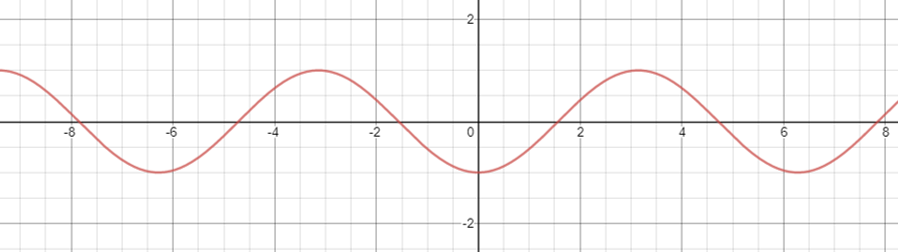
Take the function 

If we were to change the function to 


Our new graph 
← Didn't Know|Knew It →
Consider the function 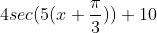 . What is the phase shift of this function?
Consider the function 
Tap to reveal answer
The general form for the secant transformation equation is  .
.  represents the phase shift of the function. When considering
 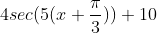 we see that
  . So our phase shift is
  and we would shift this function
  units to the left of the original secant function’s graph.
The general form for the secant transformation equation is 


← Didn't Know|Knew It →
True or False: If the function  has a phase shift of
  , then the graph will not be changed.
True or False: If the function 

Tap to reveal answer
This is true because the graph  has a period of
  , meaning it repeats itself every
  units. So if
  has a phase shift of any multiple of
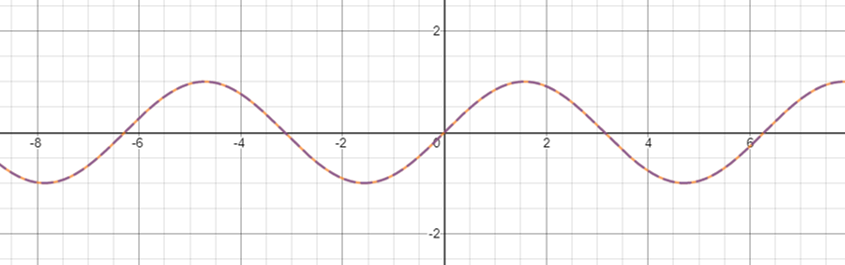
 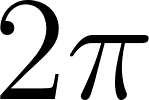 , then it will just overlay the original graph. This is shown below. In orange is the graph of
  and in purple is the graph of
  .
.
This is true because the graph 


← Didn't Know|Knew It →
Which of the following is the graph of  with a phase shift of
  ?
?
Which of the following is the graph of 

Tap to reveal answer
Start this problem by graphing the function of tangent.
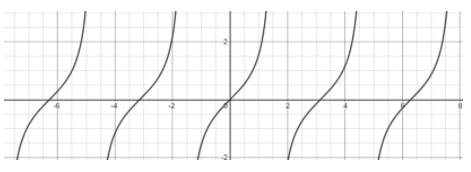
Now we need to shift this graph  to the right.
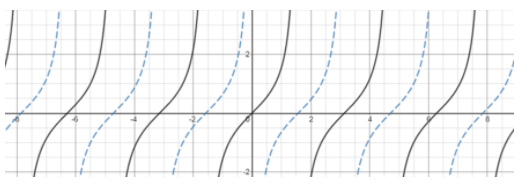
This gives us our answer
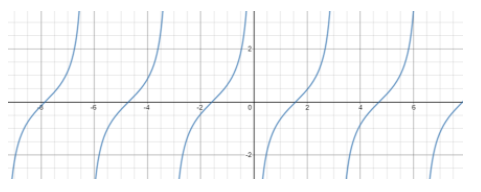
Start this problem by graphing the function of tangent.
Now we need to shift this graph 
This gives us our answer
← Didn't Know|Knew It →
True or False: The function  has a phase shift of
  .
.
True or False: The function 

Tap to reveal answer
The form of the general cosecant function is  . So if we have
  then
then  , which represents the phase shift, is equal to
  . This gives us a phase shift of
  .
.
The form of the general cosecant function is 


← Didn't Know|Knew It →
Which of the following is the phase shift of the function  ?
?
Which of the following is the phase shift of the function 
Tap to reveal answer
The general form of the cotangent function is  . So first we need to get
  into the form
  .
.

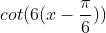
From this we see that  giving us our answer.
The general form of the cotangent function is 


From this we see that 
← Didn't Know|Knew It →
Which of the following is equivalent to
Which of the following is equivalent to
Tap to reveal answer
The first zero can be found by plugging 3π/2 for x, and noting that it is a double period function, the zeros are every π/2, count three back and there is a zero at zero, going down.
A more succinct form for this answer is but that was not one of the options, so a shifted cosine must be the answer.
The first positive peak is at π/4 at -1, so the cosine function will be shifted π/4 to the right and multiplied by -1. The period and amplitude still 2, so the answer becomes .
To check, plug in π/4 for x and it will come out to -2.
The first zero can be found by plugging 3π/2 for x, and noting that it is a double period function, the zeros are every π/2, count three back and there is a zero at zero, going down.
A more succinct form for this answer is
The first positive peak is at π/4 at -1, so the cosine function will be shifted π/4 to the right and multiplied by -1. The period and amplitude still 2, so the answer becomes
To check, plug in π/4 for x and it will come out to -2.
← Didn't Know|Knew It →
Identify the phase shift of the following equation.
Identify the phase shift of the following equation.
Tap to reveal answer
If we use the standard form of a sine function
the phase shift can be calculated by . Therefore, in our case, our phase shift is
If we use the standard form of a sine function
the phase shift can be calculated by
← Didn't Know|Knew It →
Which of the following is the correct definition of a phase shift?
Which of the following is the correct definition of a phase shift?
Tap to reveal answer
Take the function for example. The graph for is
If we were to change the function to , our phase shift is . This means we need to shift our entire graph units to the left.
Our new graph is the following
Take the function
If we were to change the function to
Our new graph
← Didn't Know|Knew It →
Consider the function . What is the phase shift of this function?
Consider the function
Tap to reveal answer
The general form for the secant transformation equation is . represents the phase shift of the function. When considering we see that . So our phase shift is and we would shift this function units to the left of the original secant function’s graph.
The general form for the secant transformation equation is
← Didn't Know|Knew It →
True or False: If the function has a phase shift of , then the graph will not be changed.
True or False: If the function
Tap to reveal answer
This is true because the graph has a period of , meaning it repeats itself every units. So if has a phase shift of any multiple of , then it will just overlay the original graph. This is shown below. In orange is the graph of and in purple is the graph of .
This is true because the graph
← Didn't Know|Knew It →
Which of the following is the graph of with a phase shift of ?
Which of the following is the graph of
Tap to reveal answer
Start this problem by graphing the function of tangent.
Now we need to shift this graph to the right.
This gives us our answer
Start this problem by graphing the function of tangent.
Now we need to shift this graph
This gives us our answer
← Didn't Know|Knew It →
True or False: The function has a phase shift of .
True or False: The function
Tap to reveal answer
The form of the general cosecant function is . So if we have then , which represents the phase shift, is equal to . This gives us a phase shift of .
The form of the general cosecant function is
← Didn't Know|Knew It →
Which of the following is the phase shift of the function ?
Which of the following is the phase shift of the function
Tap to reveal answer
The general form of the cotangent function is . So first we need to get into the form .
From this we see that giving us our answer.
The general form of the cotangent function is
From this we see that
← Didn't Know|Knew It →
Which of the following is equivalent to
Which of the following is equivalent to
Tap to reveal answer
The first zero can be found by plugging 3π/2 for x, and noting that it is a double period function, the zeros are every π/2, count three back and there is a zero at zero, going down.
A more succinct form for this answer is but that was not one of the options, so a shifted cosine must be the answer.
The first positive peak is at π/4 at -1, so the cosine function will be shifted π/4 to the right and multiplied by -1. The period and amplitude still 2, so the answer becomes .
To check, plug in π/4 for x and it will come out to -2.
The first zero can be found by plugging 3π/2 for x, and noting that it is a double period function, the zeros are every π/2, count three back and there is a zero at zero, going down.
A more succinct form for this answer is
The first positive peak is at π/4 at -1, so the cosine function will be shifted π/4 to the right and multiplied by -1. The period and amplitude still 2, so the answer becomes
To check, plug in π/4 for x and it will come out to -2.
← Didn't Know|Knew It →
Identify the phase shift of the following equation.
Identify the phase shift of the following equation.
Tap to reveal answer
If we use the standard form of a sine function
the phase shift can be calculated by . Therefore, in our case, our phase shift is
If we use the standard form of a sine function
the phase shift can be calculated by
← Didn't Know|Knew It →
Which of the following is the correct definition of a phase shift?
Which of the following is the correct definition of a phase shift?
Tap to reveal answer
Take the function for example. The graph for is
If we were to change the function to , our phase shift is . This means we need to shift our entire graph units to the left.
Our new graph is the following
Take the function
If we were to change the function to
Our new graph
← Didn't Know|Knew It →
Consider the function . What is the phase shift of this function?
Consider the function
Tap to reveal answer
The general form for the secant transformation equation is . represents the phase shift of the function. When considering we see that . So our phase shift is and we would shift this function units to the left of the original secant function’s graph.
The general form for the secant transformation equation is
← Didn't Know|Knew It →