Pythagorean Identities - Trigonometry
Card 1 of 96
Simplify  .
.
Simplify
Tap to reveal answer
Recognize that  is a reworking on
  , meaning that
  .
.
Plug that in to our given equation:

Notice that one of the  's cancel out.
 .
.
Recognize that
Plug that in to our given equation:
Notice that one of the
← Didn't Know|Knew It →
Simplify

Simplify
Tap to reveal answer
The first step to simplifying is to remember an important trig identity.

If we rewrite it to look like the denominator, it is.

Now we can substitute this in the denominator.

Now write each term separately.

Remember the following identities.

Now simplify, and combine each term.

The first step to simplifying is to remember an important trig identity.
If we rewrite it to look like the denominator, it is.
Now we can substitute this in the denominator.
Now write each term separately.
Remember the following identities.
Now simplify, and combine each term.
← Didn't Know|Knew It →

Tap to reveal answer

Recall the Pythagorean Identity:

We can rearrange the terms:

This is exactly what our original equation looks like, so the answer is 1.
Recall the Pythagorean Identity:
We can rearrange the terms:
This is exactly what our original equation looks like, so the answer is 1.
← Didn't Know|Knew It →
Simplify  .
.
Simplify
Tap to reveal answer
To simplify, recognize that is a reworking on , meaning that .
Plug that into our given equation:
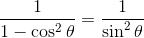
Remember that  , so
, so 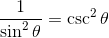 .
.
To simplify, recognize that
Plug that into our given equation:
Remember that
← Didn't Know|Knew It →
Simplify the expression: 
Simplify the expression:
Tap to reveal answer
The expression  represents a difference of squares. In this case, the product is
  (remember that 1 is also a perfect square).
One Pythagoran identity for trigonometric functions is:

Thus, we can say that the most simplified version of the expression is  .
.
The expression
One Pythagoran identity for trigonometric functions is:
Thus, we can say that the most simplified version of the expression is
← Didn't Know|Knew It →
Simplify the equation using identities:

Simplify the equation using identities:
Tap to reveal answer
There are a couple valid strategies for solving this problem. The simplest is to first factor out  from both sides. This leaves us with:

Next, substitute with the known identity  to get:

From here, we can eliminate the quadratic by converting:

giving us

Thus,

There are a couple valid strategies for solving this problem. The simplest is to first factor out
Next, substitute with the known identity
From here, we can eliminate the quadratic by converting:
giving us
Thus,
← Didn't Know|Knew It →
If theta is in the second quadrant, and  , what is
  ?
?
If theta is in the second quadrant, and
Tap to reveal answer
Write the Pythagorean Identity.

Substitute the value of  and solve for
  .
.


Since the cosine is in the second quadrant, the correct answer is:

Write the Pythagorean Identity.
Substitute the value of
Since the cosine is in the second quadrant, the correct answer is:
← Didn't Know|Knew It →

Tap to reveal answer
By the Pythagorean identity, the first two terms simplify to 1:
 .
.
Dividing the Pythagorean identity by  allows us to simplify the right-hand side.


By the Pythagorean identity, the first two terms simplify to 1:
Dividing the Pythagorean identity by
← Didn't Know|Knew It →
For which values of  is the following equation true?

For which values of
Tap to reveal answer
According to the Pythagorean identity
 ,
,
the right hand side of this equation can be rewritten as  . This yields the equation
 .
.
Dividing both sides by  yields:
 .
.
Dividing both sides by  yields:
 .
.
This is precisely the definition of the tangent function; since the domain of  consists of all real numbers, the values of
  which satisfy the original equation also consist of all real numbers. Hence, the correct answer is
 .
.
According to the Pythagorean identity
the right hand side of this equation can be rewritten as
Dividing both sides by
Dividing both sides by
This is precisely the definition of the tangent function; since the domain of
← Didn't Know|Knew It →
What is  equal to?
What is
Tap to reveal answer
Step 1: Recall the trigonometric identity that has sine and cosine in it...

The sum is equal to 1.
Step 1: Recall the trigonometric identity that has sine and cosine in it...
The sum is equal to 1.
← Didn't Know|Knew It →
Given  , what is
  ?
?
Given
Tap to reveal answer
Using the Pythagorean Identity
 ,
,
one can solve for  by plugging in
  for
for  .
.
Solving for  , you get it equal to
  .
.
Taking the square root of both sides will get the correct answer of
 .
.
Using the Pythagorean Identity
one can solve for
Solving for
Taking the square root of both sides will get the correct answer of
← Didn't Know|Knew It →
Reduce the following expression.
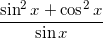
Reduce the following expression.
Tap to reveal answer
Because  ,
,
therefore:
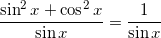
By definition of cosecant,

Because
therefore:
By definition of cosecant,
← Didn't Know|Knew It →
Reduce the following expression.

Reduce the following expression.
Tap to reveal answer
There are several ways to work this problem, but all of them use the second Pythagorean trig identity,  .
.
You can use this identity to substitute for parts of the expression. Here are two examples.
Method 1:
Substituting  for
for  , we get
 , which equals zero.
Method 2:
Substituting  for
for  , we get
 , which equals zero.
Regardless of which substitution you choose, the answer is the same.
There are several ways to work this problem, but all of them use the second Pythagorean trig identity,
You can use this identity to substitute for parts of the expression. Here are two examples.
Method 1:
Substituting
Method 2:
Substituting
Regardless of which substitution you choose, the answer is the same.
← Didn't Know|Knew It →
Simplify

Simplify
Tap to reveal answer
The first step to simplifying is to remember an important trig identity.

If we rewrite it to look like the denominator, it is.

Now we can substitute this in the denominator.

Now write each term separately.

Remember the following identities.

Now simplify, and combine each term.

The first step to simplifying is to remember an important trig identity.
If we rewrite it to look like the denominator, it is.
Now we can substitute this in the denominator.
Now write each term separately.
Remember the following identities.
Now simplify, and combine each term.
← Didn't Know|Knew It →
Simplify

Simplify
Tap to reveal answer
The first step to simplifying is to remember an important trig identity.

If we rewrite it to look like the denominator, it is.

Now we can substitute this in the denominator.

Now write each term separately.

Remember the following identities.

Now simplify, and combine each term.

The first step to simplifying is to remember an important trig identity.
If we rewrite it to look like the denominator, it is.
Now we can substitute this in the denominator.
Now write each term separately.
Remember the following identities.
Now simplify, and combine each term.
← Didn't Know|Knew It →
Simplify

Simplify
Tap to reveal answer
The first step to simplifying is to remember an important trig identity.

If we rewrite it to look like the denominator, it is.

Now we can substitute this in the denominator.

Now write each term separately.

Remember the following identities.

Now simplify, and combine each term.

The first step to simplifying is to remember an important trig identity.
If we rewrite it to look like the denominator, it is.
Now we can substitute this in the denominator.
Now write each term separately.
Remember the following identities.
Now simplify, and combine each term.
← Didn't Know|Knew It →
Simplify

Simplify
Tap to reveal answer
The first step to simplifying is to remember an important trig identity.

If we rewrite it to look like the denominator, it is.

Now we can substitute this in the denominator.

Now write each term separately.

Remember the following identities.

Now simplify, and combine each term.

The first step to simplifying is to remember an important trig identity.
If we rewrite it to look like the denominator, it is.
Now we can substitute this in the denominator.
Now write each term separately.
Remember the following identities.
Now simplify, and combine each term.
← Didn't Know|Knew It →
Simplify

Simplify
Tap to reveal answer
The first step to simplifying is to remember an important trig identity.

If we rewrite it to look like the denominator, it is.

Now we can substitute this in the denominator.

Now write each term separately.

Remember the following identities.

Now simplify, and combine each term.

The first step to simplifying is to remember an important trig identity.
If we rewrite it to look like the denominator, it is.
Now we can substitute this in the denominator.
Now write each term separately.
Remember the following identities.
Now simplify, and combine each term.
← Didn't Know|Knew It →
Simplify

Simplify
Tap to reveal answer
The first step to simplifying is to remember an important trig identity.

If we rewrite it to look like the denominator, it is.

Now we can substitute this in the denominator.

Now write each term separately.

Remember the following identities.

Now simplify, and combine each term.

The first step to simplifying is to remember an important trig identity.
If we rewrite it to look like the denominator, it is.
Now we can substitute this in the denominator.
Now write each term separately.
Remember the following identities.
Now simplify, and combine each term.
← Didn't Know|Knew It →
Simplify

Simplify
Tap to reveal answer
The first step to simplifying is to remember an important trig identity.

If we rewrite it to look like the denominator, it is.

Now we can substitute this in the denominator.

Now write each term separately.

Remember the following identities.
 Now simplify, and combine each term.

The first step to simplifying is to remember an important trig identity.
If we rewrite it to look like the denominator, it is.
Now we can substitute this in the denominator.
Now write each term separately.
Remember the following identities.
← Didn't Know|Knew It →