Quadratic Formula with Trigonometry - Trigonometry
Card 1 of 112

What are the zeros of the function listed above for the interval  .
.
What are the zeros of the function listed above for the interval
Tap to reveal answer
When the quadratic formula is applied to the function, it yields

So those are the zeros for sine, but sine has a minimum of -1, so -2 is out. For -1/2, sine achieves that twice in a cycle, at π+π/6 and 2π-π/6. So while -π/6 is true, it is not correct since it is not in the given interval.
Therefore on the given interval the zeros are:

When the quadratic formula is applied to the function, it yields
So those are the zeros for sine, but sine has a minimum of -1, so -2 is out. For -1/2, sine achieves that twice in a cycle, at π+π/6 and 2π-π/6. So while -π/6 is true, it is not correct since it is not in the given interval.
Therefore on the given interval the zeros are:
← Didn't Know|Knew It →
Solve the following equation for  .
.

Solve the following equation for
Tap to reveal answer
 ; Use the double angle identity for cosine.
 ; Move everything to the left side of the equation.
 ; This is a quadratic-like expression that cannot be factored. We must use the quadratic formula. It may be helpful to see this if you replace
  with
with  , so it becomes:

Recall the quadratic formula 
plug in  .
.
We now have
 ; Separate this into two equations and take the inverse sine.
 or
or 
The first equation gives us  . Using the unit circle as we did in previous problems, we can find a second answer from this which is
  . The second equation will not give us a solution.
Recall the quadratic formula
plug in
We now have
The first equation gives us
← Didn't Know|Knew It →
Solve the following trigonometric equation:

for 
Solve the following trigonometric equation:
for
Tap to reveal answer
Since  can be written as:
 . We can't have
  .
.
Therefore  . This means that
  where k is an integer.
since  . We have x=0 is the only number that satisfies this property.
Since
Therefore
since
← Didn't Know|Knew It →
Solve each equation over the domain  (answer in degrees).

Solve each equation over the domain
Tap to reveal answer
Rearrange the problem,


Over the interval 0 to 360 degrees, cosx = 1/2 at 60 degrees and 300 degrees.
Rearrange the problem,
Over the interval 0 to 360 degrees, cosx = 1/2 at 60 degrees and 300 degrees.
← Didn't Know|Knew It →
Solve the equation over the interval 

Solve the equation over the interval
Tap to reveal answer
First, get the equation in terms of one trig function. We can do this by substituting in using the Pythagorean Identity for  .
.
Then we have  .
.
Bring all the terms to one side to find that  .
.
We can factor this quadratic to  .
.
This means that  .
.
The only angle value for which this is true is  .
.
First, get the equation in terms of one trig function. We can do this by substituting in using the Pythagorean Identity for
Then we have
Bring all the terms to one side to find that
We can factor this quadratic to
This means that
The only angle value for which this is true is
← Didn't Know|Knew It →
Solve for  :
:
 .
.
Give your answer as a positive angle measure.
Solve for
Give your answer as a positive angle measure.
Tap to reveal answer
Use the quadratic formula to solve for x. In this case, the coefficients a, b, and c are a=4, b=1, and c=-1:
 simplify


the square root of 17 is about 4.123. This gives two potential answers:
 . We can solve for x by evaluating both
  and
and  . The first gives an answer of
  . Add this to 360 to get that as a positive angle measure,
  . If this has a sine of -0.64, so does its reflection over the y-axis, which is
  .
.
The second gives an answer of  . If that has a sine of 0.39, then so does its reflection over the y-axis, which is
  .
.
Use the quadratic formula to solve for x. In this case, the coefficients a, b, and c are a=4, b=1, and c=-1:
the square root of 17 is about 4.123. This gives two potential answers:
The second gives an answer of
← Didn't Know|Knew It →
Solve for  , giving your answer as a positive angle measure:

Solve for
Tap to reveal answer
First, re-write the equation so that it is equal to zero: 
Now we can use the quadratic formula to solve for x. In this case, the coefficients a, b, and c are a=1, b=2, and c=-3:
 simplify


This gives two potential answers:

and

Sine must be between -1 and 1, so there are no values of x that would give a sine of -3. The only solution that works is  . The only angle measure that has a sine of 1 is
  .
.
First, re-write the equation so that it is equal to zero:
Now we can use the quadratic formula to solve for x. In this case, the coefficients a, b, and c are a=1, b=2, and c=-3:
This gives two potential answers:
and
Sine must be between -1 and 1, so there are no values of x that would give a sine of -3. The only solution that works is
← Didn't Know|Knew It →
Solve for  :
: 
Solve for
Tap to reveal answer
There are multiple solution paths. We could subtract 1 from both sides and use the quadratic formula with  and
and  . Or we could solve using inverse opperations:
 divide both sides by 2
 take the square root of both sides

The unit circle tells us that potential solutions for  are
are  .
.
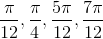
To get our final solution set, divide each by 3, giving:
 .
.
There are multiple solution paths. We could subtract 1 from both sides and use the quadratic formula with
The unit circle tells us that potential solutions for
To get our final solution set, divide each by 3, giving:
← Didn't Know|Knew It →
Solve for  :
: 
Solve for
Tap to reveal answer
This problem has multiple solution paths, including subtracting 5 from both sides and using the quadratic formula with  . We can also solve using inverse opperations:
 subtract 2 from both sides
 divide both sides by 4
 take the square root of both sides

If the sine of an angle is  , that angle must be one of
  . Since the angle is
  , we can get theta by subtracting
  :
:


This problem has multiple solution paths, including subtracting 5 from both sides and using the quadratic formula with
If the sine of an angle is
← Didn't Know|Knew It →
Solve for  :
: 
Solve for
Tap to reveal answer
To solve, use the quadratic formula with  and
and  where x would normally be:

This gives us two potential answers:
 since this number is greater than 1, it is outside of the domain for cosine and won't give us any solutions.

Consulting the unit circle, the cosine is  when
when 
To solve, use the quadratic formula with
This gives us two potential answers:
Consulting the unit circle, the cosine is
← Didn't Know|Knew It →
Solve for  :
: 
Solve for
Tap to reveal answer
To start solving, first realize that this is a quadratic with "x" as  :
:

We can solve using the quadratic formula:

One potential solution: 
Taking the square root gives:  , but 2 is outside the range of cosine, so that won't work.
The other potential solution: 
Taking the square root gives: 
Consulting the unit circle, 
To start solving, first realize that this is a quadratic with "x" as
We can solve using the quadratic formula:
One potential solution:
Taking the square root gives:
The other potential solution:
Taking the square root gives:
Consulting the unit circle,
← Didn't Know|Knew It →
Solve for  :
: 
Solve for
Tap to reveal answer
To solve, first use the quadratic formula:

This gives us two potential solutions:
 that is outside the range of sine, so it won't work

We can continue solving by taking the inverse sine:

using a calculator gives us
 , which we can convert to a positive angle measure by adding to 360:

This is just one answer for  . The other angle that would work would be
  below
below  , or
, or 
Since those are values for  , to get our final answers divide by 2:

To solve, first use the quadratic formula:
This gives us two potential solutions:
We can continue solving by taking the inverse sine:
using a calculator gives us
This is just one answer for
Since those are values for
← Didn't Know|Knew It →
Solve for  :
: 
Solve for
Tap to reveal answer
First solve using the quadratic formula:

This gives two potential solutions:

The only value for  where sine is 1 is
  .
.

Using a calculator, we get 
Adding that to 360 givesus the angle's positive value, 
That's just one instance where the sine is -0.75. We also need to find the other angle  below the x-axis by adding
  .
.
So our three values for theta are 
First solve using the quadratic formula:
This gives two potential solutions:
The only value for
Using a calculator, we get
Adding that to 360 givesus the angle's positive value,
That's just one instance where the sine is -0.75. We also need to find the other angle
So our three values for theta are
← Didn't Know|Knew It →
Solve for  :
: 
Solve for
Tap to reveal answer
First, solve for  using the quadratic formula:

This gives two solutions:
 this is outside of the range of cosine so it will not work.

Consulting the unit circle tells us that  or
or  . To get our final answers, just divide these by 4:

First, solve for
This gives two solutions:
Consulting the unit circle tells us that
← Didn't Know|Knew It →
Solve for  :
: 
Solve for
Tap to reveal answer
First, solve for  by using the quadratic formula:

This gives two solutions:
 this is outside of the range for cosine, so that does not work as a solution

To solve for theta, take the inverse of cosine of both sides:

 according to the calculator. That's just one potential value, though. The other angle that would have a cosine of positive 0.6 would be 53.13 degrees below the x-axis in quadrant IV, so subtract from 360:

That gives us two values for  , so to get theta we have to subtract 1:

First, solve for
This gives two solutions:
To solve for theta, take the inverse of cosine of both sides:
That gives us two values for
← Didn't Know|Knew It →
Solve for  :
: 
Solve for
Tap to reveal answer
First solve for  using the quadratic formula:

One answer is  this is outside the range for cosine, so it does not work as a solution
The other answer is 
To solve for theta, take the inverse cosine using a calculator:

This is just one answer for theta, in quadrant II. Cosine is also negative in quadrant III, so we want to find the angle there with the same cosine. This would be  , or
, or 
First solve for
One answer is
The other answer is
To solve for theta, take the inverse cosine using a calculator:
This is just one answer for theta, in quadrant II. Cosine is also negative in quadrant III, so we want to find the angle there with the same cosine. This would be
← Didn't Know|Knew It →
Which is not a solution for  :
: 
Which is not a solution for
Tap to reveal answer
To solve, use the quadratic formula:

This gives two solutions.
The first is:

Using a calculator gives us 
This is just one potential value, the one in quadrant I. Tangent is also positive in quadrant III, and we can get this angle by adding 180: 
The second solution from the quadratic formula is:

Using a calculator gives us  , which we can add to 360 to get as a positive value,
  .
.
This is just one potential value, the one in quadrant IV. Tangent is also negative in quadrant II, and we can get this angle by subtracting 180:

Dividing all four of these angles by 3 gives us 
To solve, use the quadratic formula:
This gives two solutions.
The first is:
Using a calculator gives us
This is just one potential value, the one in quadrant I. Tangent is also positive in quadrant III, and we can get this angle by adding 180:
The second solution from the quadratic formula is:
Using a calculator gives us
This is just one potential value, the one in quadrant IV. Tangent is also negative in quadrant II, and we can get this angle by subtracting 180:
Dividing all four of these angles by 3 gives us
← Didn't Know|Knew It →
Solve for  :
:

Solve for
Tap to reveal answer
Use the quadratic formula to solve for  :
:

One possible solution is:
 this is outside of the possible range for cosine
The other solution is:

 divide by 3

Use the quadratic formula to solve for
One possible solution is:
The other solution is:
← Didn't Know|Knew It →
Solve for  :
:

Solve for
Tap to reveal answer
Solve using the quadratic formula:

One possible answer is:
 take the square root


The other would be:
 this is outside of the range for sine
Solve using the quadratic formula:
One possible answer is:
The other would be:
← Didn't Know|Knew It →
Solve for  :
: 
Solve for
Tap to reveal answer
Subtracting 5 from both sides gives the quadratic equation 
Using the quadratic formula gives:

The cosine cannot be 3 because that's greater than 1.


Subtracting 5 from both sides gives the quadratic equation
Using the quadratic formula gives:
The cosine cannot be 3 because that's greater than 1.
← Didn't Know|Knew It →