Award-Winning College Physics Tutors
serving Colorado Springs, CO
College Physics
Tutors in Colorado Springs
Private 1-on-1 tutoring, weekly live classes for academic support, test prep & enrichment, practice tests and diagnostics, and more to elevate grades and test scores.
Based on 3.4M Learner Ratings
UniversitiesSchools & Universities
DeliveredHours Delivered
ProficiencyGrowth in Proficiency
Who needs tutoring?
No obligation. Takes ~1 minute.

Biomedical engineering at UVA means Colton spent four years where physics meets the human body — modeling forces on prosthetics, analyzing fluid flow through vessels, and applying circuit theory to bioelectrical systems. He also TA'd courses in cell biology and MATLAB, so he's comfortable walking students through both the conceptual reasoning and the computational side of calculus-based physics problems. Rated 4.7 by students.
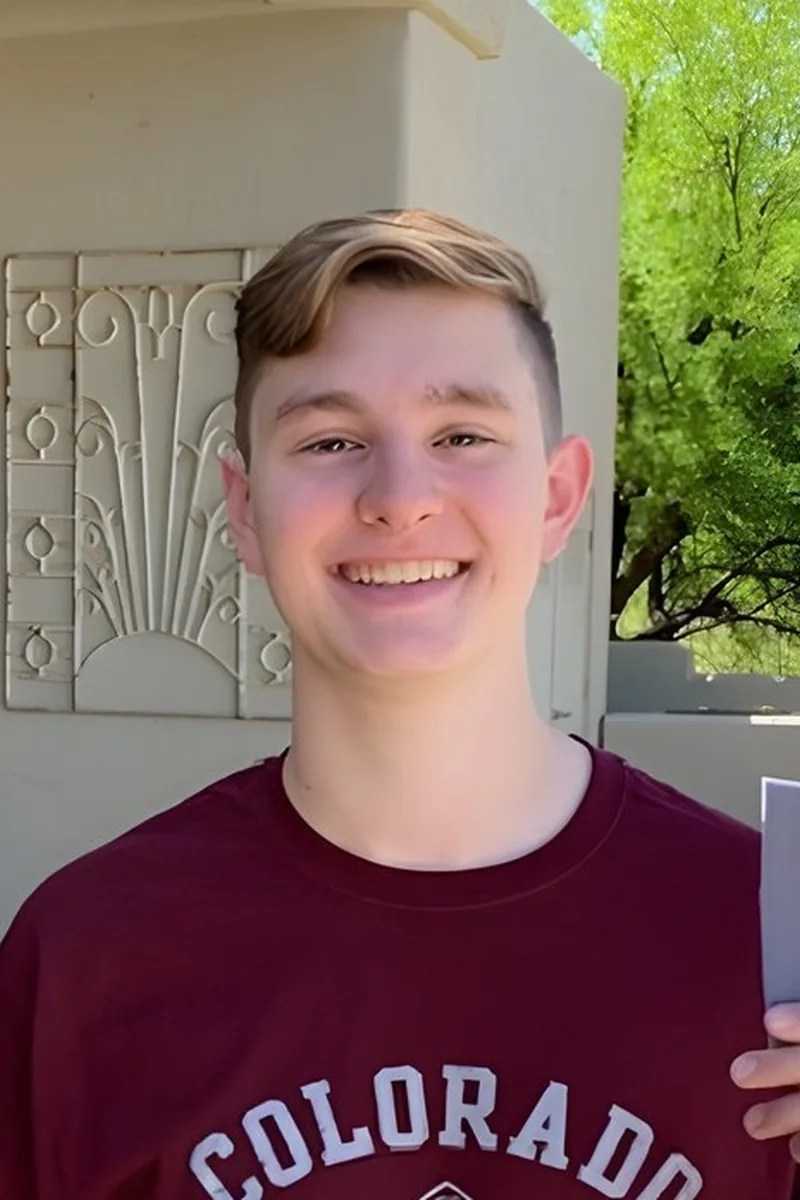
Studying engineering physics at Colorado School of Mines means Jude is taking the same calculus-based physics courses his students are — mechanics, E&M, waves, thermo — and solving the same style of problems week after week. That proximity to the material keeps his instincts sharp on exactly where a problem setup falls apart, whether it's misidentifying the system in a free-body diagram or botching a line integral through a non-uniform field. He scored a 36 ACT and holds a 4.9 tutoring rating.
Studying physical therapy at UCD means Michelle regularly applies physics to the human body — analyzing force vectors in joint movement, understanding torque during gait, and calculating work done by muscle groups — which gives her a practical anchor for the mechanics topics that dominate introductory college physics. Her biology degree from Trinity and a 4.8 tutoring rating back up her emphasis on conceptual problem-solving: mapping out the physics of a scenario before plugging anything into an equation.
Few tutors bring the depth of a dedicated Engineering Physics program to college-level physics. Cody tackles topics like Lagrangian mechanics, Maxwell's equations, and quantum fundamentals with the rigor of someone who studied them as core coursework at Colorado School of Mines. He also uses Mathematica to visualize complex systems, which is especially useful for students in calculus-based physics sequences.
Studying astrophysics and chemistry at CU Boulder means Graham lives inside the calculus-based physics that makes college courses demanding — orbital mechanics, electromagnetic radiation, thermodynamic processes in stellar atmospheres — and carries a 4.0 GPA through it. He breaks problems down by identifying the governing principle first, whether that's a conservation law or a field equation, then walks through the math step by step so the physics stays visible. Rated 5.0 by students.
Evan's physics degree means he didn't just pass college physics — he kept going, tackling thermodynamics, special relativity, and upper-division mechanics well beyond the introductory sequence. That depth lets him trace a tricky concept like rotational inertia or wave superposition back to the underlying principle instead of just drilling the formula. Rated 5.0 by students.
Biomedical engineering at Duke means Eric solves physics problems daily — modeling forces on prosthetic joints, analyzing fluid flow through artificial vessels, calculating electrical signals in biosensors — so the mechanics and electromagnetism in a college physics course map directly onto work he's already doing. He breaks multi-step problems into their physical components first, making sure the reasoning is solid before any math hits the page. Holds a 5.0 rating.
Molecular biology might seem like a different world from physics, but Annabel's coursework lives in the overlap — understanding diffusion requires thermodynamics, membrane potentials are voltage problems, and imaging techniques depend on wave optics and electromagnetism. She brings that life-sciences lens to college physics topics like energy conservation and fluid dynamics, making the material click for pre-med students who need to see why these concepts matter beyond the problem set.
A physics degree means Nima didn't just pass college physics — he built his entire undergraduate education on top of it, from classical mechanics through electromagnetism and modern physics. He breaks down multi-step problems by teaching students to identify the governing principle first, then translate it into math, which is where a 1580 SAT and deep comfort with calculus-based reasoning pay off.
Running an immunology lab at Columbia University Medical Center means Matthew applies physics daily in ways most tutors haven't — calibrating imaging equipment, analyzing force and pressure data in tissue samples, and troubleshooting instruments that depend on optics and electromagnetism. That hands-on fluency, combined with a physics degree and a 35 ACT, lets him teach college-level mechanics and E&M problems by connecting equations to the physical systems they actually describe.
Pursuing an MD at Stanford after a double major in economics and molecular/cellular biology, Maggie brings a pre-med perspective to college physics that makes topics like optics, fluid dynamics, and wave mechanics feel immediately relevant rather than abstract. She's especially sharp at teaching students to set up problems cleanly — translating a physical scenario into the right free-body diagram or energy equation before doing any math. Rated 5.0 by students.
Theater might not scream physics, but Amber's breadth across math and science tutoring — from calculus to chemistry to AP-level coursework — means she's comfortable with the quantitative reasoning that college physics demands, and her 5.0 rating confirms students agree. She's particularly effective at teaching the problem-setup habits that separate students who flounder from those who don't: sketching free-body diagrams, identifying conservation laws, and translating word problems into equations before plugging in numbers. Her ACT 35 reflects the kind of cross-disciplinary sharpness that keeps pace with fast-moving, concept-dense courses.
Three science-focused bachelor's degrees — including biology — meant Garrett sat through the full calculus-based physics sequence and kept coming back to it in physiology and physical chemistry, where concepts like fluid dynamics, pressure gradients, and energy transfer show up again and again. That repeated exposure across disciplines gives him an intuitive feel for when to apply conservation of energy versus momentum, or how to reason through a thermodynamics problem without getting lost in the formalism. His 1530 SAT speaks to the quantitative sharpness he brings to each session.
Chemical engineering at Vanderbilt means Greg solves physics problems daily — fluid mechanics, heat transfer, thermodynamics, and force balances are baked into every core course, so his explanations come from repeated, hands-on application rather than textbook summaries. His math double major gives him the calculus fluency to walk through derivations cleanly, especially when problems involve integration over continuous systems or solving second-order differential equations of motion. Rated 5.0 by students.
Building things that actually work — which is what mechanical engineering is — means Vania spent her degree applying Newton's laws to real structures, calculating heat transfer through materials, and analyzing fluid flow, not as textbook exercises but as design requirements. That hands-on engineering intuition shows up when she breaks down free-body diagrams or walks through energy conservation problems, because she's solved versions of them that had to hold up in the physical world. Her 1590 SAT underscores the quantitative precision she brings to calculus-based problem solving.
Chemical engineering at Georgia Tech means Aimee's spent years solving problems that blend thermodynamics, fluid mechanics, and energy balances — the same physics concepts that make college-level courses demanding, except she's applied them to reactor design and process optimization. Her biosystems engineering graduate work adds another layer, connecting classical mechanics and heat transfer to biological systems in ways that make abstract problem sets feel more concrete. Rated 4.9 by students.
A dual BS in physics and math from Yale means Anthony didn't just take college physics — he took the honors sequence and then kept going through differential equations, multivariable calculus, and upper-division mechanics. His PhD work in economics at Yale still draws on that training daily, since building economic models requires the same setup-and-solve discipline as a multi-step Newton's law problem. Rated 5.0 by students.
Environmental engineering is essentially physics with consequences — Kate's master's work required her to model fluid flow, heat transfer, and pressure systems in real infrastructure, which means she's solved the same types of problems that show up on college physics exams but with actual design constraints attached. That applied perspective makes her particularly effective at teaching students to set up force balances and energy equations from a physical scenario rather than reverse-engineering from a formula sheet. Rated 4.9 by students.
Testimonials
Because the right College Physics tutor makes all the difference.
Average Session Rating – Based on 3.4M Learner Ratings
Nearby College Physics Tutors
Other Colorado Springs Tutors
Related Science Tutors in Colorado Springs
Frequently Asked Questions
College Physics students often struggle with translating abstract theoretical concepts into real-world applications, especially when visualizing forces, motion, and energy at different scales. Many students also find unit conversions and dimensional analysis challenging, and connecting mathematical problem-solving to the underlying physics principles requires a shift from memorization to deep conceptual understanding. Personalized tutoring helps bridge these gaps by breaking down complex ideas and showing how physics governs everything from everyday situations to advanced engineering applications.
Expert tutors can help you understand the scientific method, design experiments properly, analyze data accurately, and connect lab results back to theoretical concepts you're learning in lectures. They can also guide you through error analysis, help you interpret graphs and measurements, and prepare you to think critically about why experiments succeed or fail. This support strengthens both your experimental skills and your overall physics reasoning.
Understanding concepts is far more valuable than memorizing formulas—physics is about grasping why things work, not just plugging numbers into equations. When you truly understand the underlying principles, you can solve novel problems, apply physics to new situations, and actually remember what you've learned long-term. A tutor can help you build that conceptual foundation so formulas become tools for expressing ideas you already understand, rather than mysterious rules to memorize.
Your first session focuses on understanding your specific challenges—whether that's grasping Newton's laws, working with energy and momentum, or tackling electromagnetism and waves. The tutor will assess your current understanding, identify gaps, and create a personalized plan tailored to your course pace and goals. This foundation ensures that every session afterward targets exactly what will help you most.
Expert tutors use multiple strategies to make abstract ideas concrete—drawing force diagrams, using real-world analogies, working through step-by-step problem breakdowns, and connecting concepts to things you can observe or experience. For example, understanding circular motion becomes clearer when you connect it to spinning objects or planetary orbits, and electrostatics makes more sense when visualized through field diagrams. This multi-sensory approach helps your brain build stronger mental models of how physics actually works.
Unit conversions and dimensional analysis require you to think about what quantities actually represent and how they relate to each other—it's not just mechanical arithmetic. Many students rush through these steps or treat them as busywork, but they're actually powerful tools for checking your work and understanding whether your answer makes physical sense. A tutor can teach you to use dimensional analysis strategically, turning it from a frustrating chore into a confidence-building problem-solving technique.
Many students notice clearer understanding of specific topics within 2-3 sessions, especially when a tutor targets the exact concepts causing confusion. Significant improvement in overall performance and confidence typically develops over 4-8 weeks of consistent tutoring, depending on your starting point and how much time you dedicate to practice between sessions. The key is consistent, focused work that builds both conceptual understanding and problem-solving skills.
Look for tutors with strong backgrounds in physics—ideally with college-level physics experience, physics education training, or success helping other students master the subject. Beyond credentials, the best tutors can explain complex ideas clearly, adapt their teaching to how you learn, and help you develop genuine understanding rather than surface-level memorization. Varsity Tutors connects you with experienced tutors in Colorado Springs who can provide the personalized instruction you need to succeed.
Let’s find your perfect tutor
Answer a few quick questions. We’ll recommend the right plan and match you with a top 5% tutor.